On the long wait
My debut novel, The Bicycle Messenger, releases at the beginning of August! You can preorder the book here to read the first chapter. In the meantime, take another look at this gorgeous cover art designed by the talented Roseanna White:
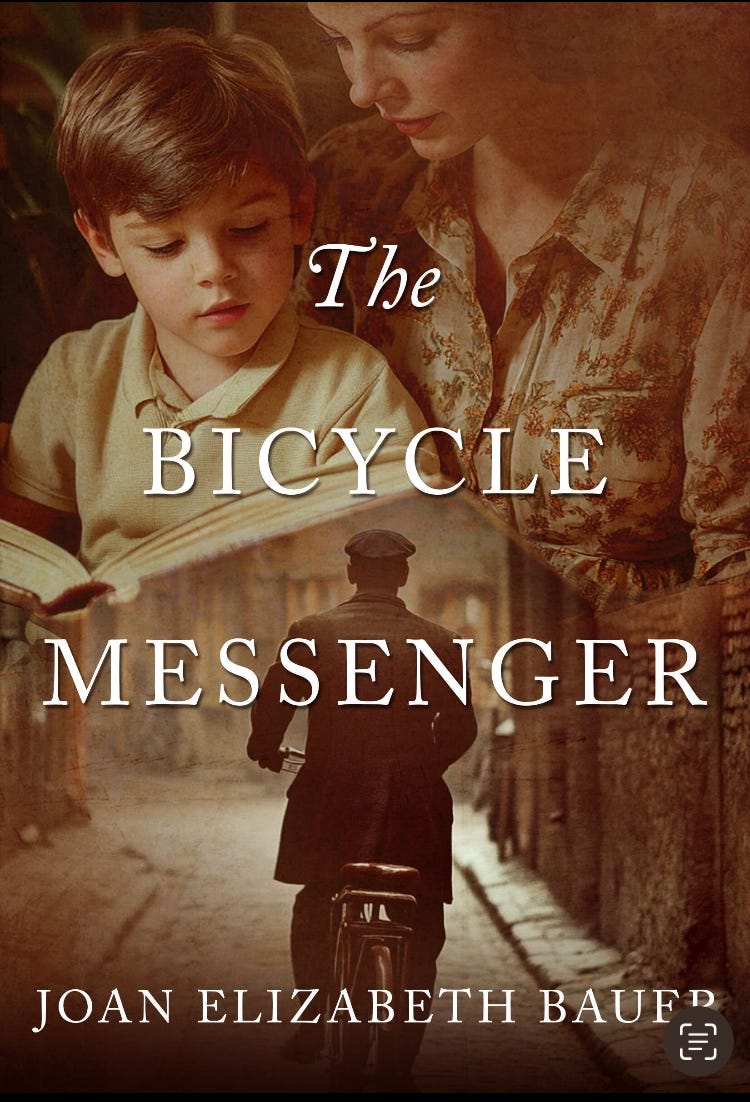
The book crosses decades and continents. In the 1970s, Charles and Mary Ellen Hawley adopt seven-year-old Steven when his mother, who suffers from schizophrenia, is unable to care for him. Years later, Steven’s quest for the truth about his family of origin plunges him into the dark history of the Nazi occupation of Poland. But first, Steven falls in love—though his own mental illness impinges upon his burgeoning relationship. In this snippet, Steven’s girlfriend Megan becomes increasingly uneasy as Steven recounts a youthful drunken escapade:
Megan was beginning to wish that Steven hadn’t told her these things. The giddy teenager who’d stepped out of the forest like a wood sprite to gloat over past mischief had withdrawn just as quickly as he’d come; but he frightened her as though she had encountered a magical creature, a shape-shifter whose true nature was something dark, wild, and raging.
Who is Steven Hawley, really? And can Megan stick around long enough to find out?
Publishing a novel has been my life-long dream—ever since my mother used to send my childhood scribblings to her brother, a Jesuit priest, for his amusement. My Jesuit uncle visited every year, and once, he brought a friend who taught English at the university level. This dear friend of his sat down with me for half an hour to analyze the opening paragraph of a Nancy Drew knockoff I’d written (“The Case of the Crystal Swan,” complete with illustrations). I was probably twelve. He’d redlined that first paragraph thoroughly. But then he told me: “you have something here. I can feel it.” Imagine that busy Jesuit, a college professor, taking the time to read and analyze the work of his friend’s twelve-year-old niece. Imagine my uncle taking the time to share it with him. All these kindnesses helped me to see myself as a writer speaking to readers when I was young.
Later, when I was in college, I gave a short story of mine to a friend to read. This friend had done a summer writing workshop somewhere—let’s say it was Harvard. I had a terrible crush on him at the time. He smoked way too much and stayed up all night writing plays that were performed on our campus. He wrote songs and played lead guitar in a band. He tried to explain to me that my story had no structure. He took a sheet of paper and drew a straight line interspersed with the occasional little clump of what looked like mashed potatoes. “This is your plot,” he told me. “There’s no rising action, no crisis.”
I wasn’t sure I entirely agreed with that tough critique; and yet I continued to drift, writing mostly in secret. It took me years to develop a voice and find something to say. Thank God for my husband Paul, who listened and read and understood the effort I was making, helping me to improve even as he crafted his own beautiful novels. (You can read more about Paul’s work here). I’ve already told this story about an agent who eagerly read a previous manuscript of mine but ended up wishing the main character would get hit by a bus. I managed to laugh about that one eventually. Still, after a lot more rejections, I started to worry. What if I never found a way to bring my books into the world? Could I be content if no one else read them but God?
When the Song of Songs speaks of the beloved as “a fountain sealed, a garden enclosed,” I think of Mary’s hidden life in Nazareth, of her perfect surrender of her life and her will to the Lord, who is the true reader of hearts. Even if a book is never published, I thought, surely the writing of it under His tutelage would form me in some way to do His will more faithfully.
But as we all know, Mary’s hidden life produced beautiful fruit; and a book, which is also God’s gift, is meant to be read. A book without a reader is like an empty dish, a cup that will never be filled, a garden enclosed that never bears fruit. I’m so grateful to my husband for reading for me all these years. And I love to read and promote the work of contemporary Catholic novelists and poets, because good writers need faithful readers who will bear witness to the beautiful work God is doing in them. Perhaps our job after all is simply to hold out our cups, cracked and flawed though they might be, and trust God to fill them and find the right way to share them. I’m so honored that my debut novel found an award-winning Catholic publisher in Chrism Press. It was well worth the wait. And I give thanks that, with their help, I can soon share the fruits of my own little garden with you.
 Joan Elizabeth Bauer