Mysterious Antecedents

The gift keeps unfolding.

Recent Reads

May 04, 2026

Publishing a novel after years of writing in secret has unlocked the joys of heartfelt responses from friends. People who never knew that side of me have taken the time to read, ask questions, and share their delight. And while I’m so grateful for their kind words, I still experience a moment of terror at being found out.

A week or so ago, my husband Paul and I had the most extraordinary conversation with Ira, who was the best man at our wedding. Paul and Ira became friends in graduate school at Duke in the mid-eighties; Paul studied English, while Ira earned a Ph.D. in Mechanical Engineering. Ira once asked Paul to make him a list of the one hundred greatest novels ever written, and he eventually read them all. He’s read all of my husband’s books, too.

Ira now lives in Paris with his family, and while I’m always delighted to see him, I’m happy to take a back seat while he and Paul talk. When Ira brought his French wife and daughter to visit us in Milwaukee several years ago, I was so nervous about cooking for them that I ended up making a family-style meal from my childhood: casserole and Jell-o. I felt like a rube, but we had a great time.

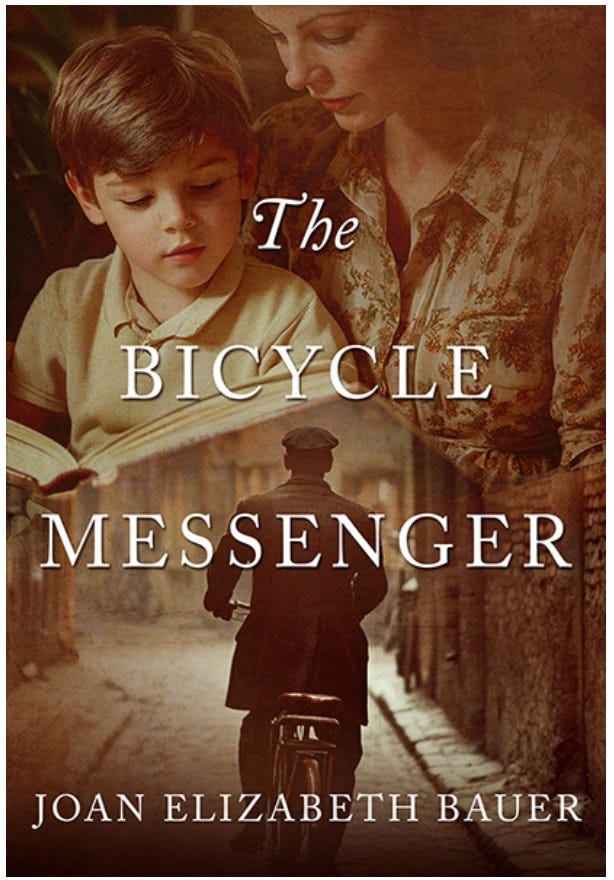
During an annual birthday call earlier this month, Paul mentioned my book to Ira as he was recounting the highlights of our family’s year. That was barely two weeks ago, so when Paul told me that Ira now wanted to talk to me over FaceTime, I didn’t know what to expect. The Bicycle Messenger tells the story of a family dealing with a loved one’s mental illness. And while the circumstances are fictional, Ira’s own memoir on the subject, co-written with his now-deceased brother Stan, is listed in the acknowledgements. Even so, I’d never told Ira just how much his relationship with his brother, who suffered from bipolar disorder, had inspired me.

My hair was still wet from the shower, poised to spring into random waves as it dried, but oh, well. I had to face the music, ready or not. Don’t worry, my husband promised as he got ready to dial the call. Ira said he couldn’t put it down!

And of course, Ira graciously set me at ease. He was touched to find his name right next to Roman Polanski’s* in the acknowledgements, because he’d had absolutely no idea what the book was about. And since he read it on Kindle, he didn’t even consult the back-cover copy. But as the story unfolded, he started asking himself, did she know about Stan? I jokingly apologized for that possibly unwelcome surprise; but Ira assured me that while the book brought back memories, they didn’t unfold in a painful way. He himself had never considered processing these experiences through fiction.

In the story, as Steven turns manic, his girlfriend Megan begins to fear him, and Ira acknowledged how realistic that was. Like Steven, Ira’s brother was always kind and would never hurt anyone. But he would start to look and act crazy, and some of his professional colleagues were ready to throw him away because of his illness, particularly if they had no significant prior relationship with him. And like Steven’s family members in the book, Ira never knew when he would be called upon to assist in a crisis. He described getting a phone call about Stan just as he was walking into a Final Four game the year Duke won a national championship. That was the only time he and his friends managed to get Stan the medical help he needed in the moment. No one really knows what to do in those circumstances, he said—so, no recriminations.

One particular story of Ira’s has fascinated me for years. Long before cell phones, Ira had to pursue his brother on a sudden, delusional trip to Hawaii. Once Ira had settled in and contacted local authorities, he had time on his hands, so he played a round of golf on a beautiful course while he waited for news. This idea absolutely confounded me; I couldn’t imagine having the presence of mind to play golf in the midst of that crisis. When I eventually wrote the scene in which Steven takes off for Poland in the hallucinatory belief that a long-lost family member has contacted him, I relied on my own experiences as a parent to help me to imagine his mother’s anxiety as she and her husband travel to Europe to search for their son.

I’d long known that Ira converted to Catholicism in graduate school, but we’ve rarely spoken of it except to acknowledge that his example influenced my husband. But now, Ira described how he’d leaned on his faith during those difficult times with Stan. His mother had lacked that support, since she was not a believer; whenever Stan would disappear suddenly, she would say it was as though her son were already dead.

By this point, a conversation that began in trepidation had turned spiritual. I told Ira that I always thought what he did for Stan was heroic. Ira replied that he didn’t think there was anything heroic about it. That just goes to show how little he thought to boast of his efforts to help a brother whose illness inexplicably robbed him of the fruits of his many intellectual gifts. Ira sacrificed his own comforts and plans for years for his brother Stan. And while I created very different characters and circumstances for my novel, I did my best to translate Ira’s faithfulness into my story. The Bicycle Messenger is my homage to this kind of sacrificial, self-giving love.

“Bravo,” Ira said at last, and as the conversation moved on, I settled comfortably into the back seat again. But I knew I would be unwrapping this gift for a while.

* As a child, Roman Polanski lived for a time in the Krakow ghetto in Poland, and I consulted his memoir in crafting some of the book’s historical scenes.

Yes, I did bring A Tree Grows in Brooklyn to New York City

On graciousness during Lent

Recent Reads

Mar 28, 2026

I’m pleased to tag #OpenBook Linkup on CatholicMom.com. Thanks to Carolyn Astfalk for hosting this opportunity!

Every year, the Women of St. Jude host an Ash Wednesday morning of reflection that glows with a particular hallmark of hospitality. We lay out a simple but lovely repast of home-baked breads, bundt cakes, fruit, yogurt parfaits, and goat cheese. We use real goblets for juice and plastic cups for coffee and tea. One particularly gifted member crafts such lovely table decorations that we all joke about hiring her to cater other events.

Some people might wonder why we go to so much trouble; I’ll admit, I used to wonder about that myself. But over the years, I’ve come to understand that the opportunity to be gracious is the whole point. Some of the people who gather for this event don’t often leave their homes anymore due to age and infirmity; but on Ash Wednesday, someone always makes sure they have a ride. And you’re allowed a light breakfast on fast days, right?

More importantly, we slow down for this first day of Lent and take in the graciousness of our God. This year’s speaker, a Jesuit priest, took his time drinking coffee with us before giving a wonderful talk (with an intermission!) on the Lenten homilies of Cardinal Newman. Afterward, he was in no hurry to return to his many duties but continued to chat. This was why he had come.

My husband and I traveled later that day to New York to visit our son for his birthday. We arrived at La Guardia in the rain and were picked up by a sixtyish man named Zorhan with long gray hair and a heavy Queens accent who enthralled us with his conversation. He’d been caught in a blizzard in Buffalo once with his dad after they’d worked some electrical job; driving blind in the snow, they exited the highway, ran out of gas, and were in danger of freezing to death. Taking a shovel they kept in the trunk, they abandoned the car and started to walk. When they heard what sounded like a plow coming, they hurled the shovel in its general direction of the sound, hoping to get the driver’s attention before he could hit them. The driver opened the cab and let them in, saving their lives. Zorhan warned us to watch out for DoorDash delivery scooters speeding the wrong way in New York City’s bike lanes—I never did see one of those, though I made sure to look—but the blizzard story he told us proved prophetic, because a huge snowstorm kept us in New York for an extra two days. And I know I’m just a humble Midwesterner beguiled by a talkative cabbie, but here in this “dinosaur moment”—three people taking delight in spontaneous conversation as though our cell phones didn’t exist—we found graciousness, too. It probably wasn’t until we got out that Zorhan noticed the ashes on our foreheads. We said goodbye warmly before he drove off.

Our son works long hours at a demanding job, so my husband and I tend to stick to routine when we visit: we walk or run in the park, read our books, and write for a while before we strike out at noon for a mass. On that first rainy Friday of Lent, we walked to a church on East 55th Street that purportedly offered stations of the cross afterward. But when we finally found the place, we saw that the service had been relocated to Holy Family, a sister parish several blocks away on East 47th. We finally arrived soaking wet at the start of the liturgy of the Eucharist; but then we made the most beautiful stations according to a new translation of St. Alphonsus Liguori and were granted a plenary indulgence to boot. From there, we walked to Chartwell Booksellers, a Churchill-themed bookstore in the Park Avenue Plaza on East 52nd. There, my husband struck up a long conversation with the owner, who told us several stories, including one about Churchill being struck by a car in the snow.

I say this by way of a long introduction to A Tree Grows in Brooklyn by Betty Smith, a gritty but gracious, compelling yet leisurely book that accompanied me on this journey. A friend from our Well-Read Mom group had recommended it as her favorite after we’d finished reading The Chosen by Chaim Potok, which is also set in Brooklyn—although Smith’s book takes place much earlier, beginning in 1912 and flashing back to the turn of the twentieth century. I was enthralled from the earliest pages, in which a young girl named Francie Nolan recalls collecting aluminum foil with her brother to give to the junk man on Saturday, who will exchange it for pennies they can spend in the candy store once they’ve set aside half for the tin can bank nailed to the floor in their closet at home—although Francie is allowed to keep the extra penny she gets from the junk man for enduring a pinch on the cheek.

Francie’s mother Katie, who cleans apartment buildings, puts aside her mop and pail when the children come home and sends them out to buy bread and beef tongue for their sandwiches. Poor as they are, Francie is always allowed to pour out her share of the coffee that’s offered with every meal, a prerogative she will later cherish in memory. Francie narrates that whole leisurely Saturday, including visits from family members, pick-up baseball games, library books on the fire escape, and weekly confession with one of her friends—a confession she does not agonize over but simply makes part of her day. And when Francie’s beloved father Johnny, a singing waiter with a drinking problem, brings home leftover lobster at 2:00 a.m., the whole family gets up and eats. But then Francie remembers that she’s broken her fast for communion in the morning and will have a real sin to confess the following week.

A Tree Grows in Brooklyn may be a classic coming-of-age story and a window on immigrant life; but it is also a love letter to family, broken and hardscrabble though it might be. When Francie is struggling in school, Johnny willingly fakes an address in another neighborhood so she can attend the more attractive school of her choice. There, she is caught telling an outlandish story, and we see the first glimmers of her writer’s vocation:

Francie always remembered what that kind teacher told her. ‘You know, Francie, a lot of people would think that these stories that you’re making up all the time were terrible lies because they are not the truth as people see the truth. In the future, when something comes up, you tell exactly how it happened but write down for yourself the way you think it should have happened. Tell the truth and write the story. Then you won’t get messed up.”

It was the best advice Francie ever got.

Francie learns about cruelty and depravity long before she is really old enough to understand. In a surprisingly funny passage, Francie’s mother rescues her from a sexual predator who is known to murder his victims. Francie recognizes the man in the hall of her building and is so petrified that she cannot run or even let go of the banister. When the police finally come and inquire about Francie’s swollen wrist, they learn that her mother had to hit her with the butt of a gun to make her let go; when they inquire about her bruised knees, they learn that her mother had to drag her down the hallway to safety. And in the coup de grace, Francie’s father uses carbolic acid to wash away the stain of the man’s touch on the back of her leg. (Before Johnny proffers this remedy, Francie is screaming that she wants her leg cut off.) After this terrible trauma, a doctor gives Francie a sedative and advises her mother to tell the girl it was all a dream when she wakes up. In neighborhood lore, Katie Nolan’s heroic rescue transmutes into a cautionary tale about a fierce woman brandishing a borrowed gun.

The Nolan family may be poor, and Francie’s father may be a drunk. But when he comes home every night, he sings on the stairs so they will know it’s him. Meanwhile, Katie, who has so little time for leisure, ensures that the children read passages from the Bible and Shakespeare every night. Most importantly, Francie receives the gift of faith:

Francie believed with all her heart that the altar was Calvary and that again Jesus was offered up as a sacrifice. As she listened to the consecrations, one for His Body and one for His Blood, she believed that the words of the priest were a sword which mystically separated the Blood from the Body. And she knew, without knowing how to explain why, that Jesus was entirely present, Body, Blood, Soul, and Divinity in the wine in the golden chalice and the bread on the golden plate.

I almost never have a theme for Lent, but this year, a particular verse from the gospel of Mark kept drifting into my mind: He said to them, come away to a deserted place all by yourselves and rest for a while. This passage appears shortly after Jesus has sent the twelve on mission and right before the feeding of the five thousand. It seems to me now that beginning on Ash Wednesday, I was invited to rest: in the gracious hospitality of the St. Jude ladies; in the generous conversation of the Uber driver; in the storytelling of the bookstore owner after a walk in the rain, and in the quiet daily masses we attended in the midst of our cycle of reading—even in the snowstorm that kept us confined to our son’s apartment. Just as the snow began, I spilled an entire cup of tea on my son’s work laptop. He didn’t freak out, and my husband heroically saved the computer from water damage—which would have been an inconvenience, not a catastrophe. But while I apologized over and over, my son sat on the sofa, his lips moving in prayer.

I’m sure every mother out there can imagine how happy that made me. What a way to usher in a season of Lent in which our gracious God calls us to repentance, preparing us for the moment when we will commemorate the most gracious act ever performed on anyone’s behalf. A blessed Holy Week to all.

Come to me, all you who are weary and are carrying heavy burdens, and I will give you rest. Take my yoke upon you, and learn from me; for I am gentle and humble in heart, and you will find rest for your souls. For my yoke is easy, and my burden is light. Mt 11:28-30

We Must Lay Down Our Lives

and yield up our secrets.

I read most of Shelby Foote’s Civil War trilogy in the early nineties, but I stopped for some reason on the verge of the fall of Atlanta and Sherman’s March to the Sea. Surely life intervened in some way. But perhaps I was afraid to journey through all that destruction—especially since childhood viewings of Gone with the Wind were imprinted in full Technicolor on my memory. So, let’s just say there’s a Sherman-shaped gap in my Civil War knowledge—or, rather, in my mythology.

Not anymore.

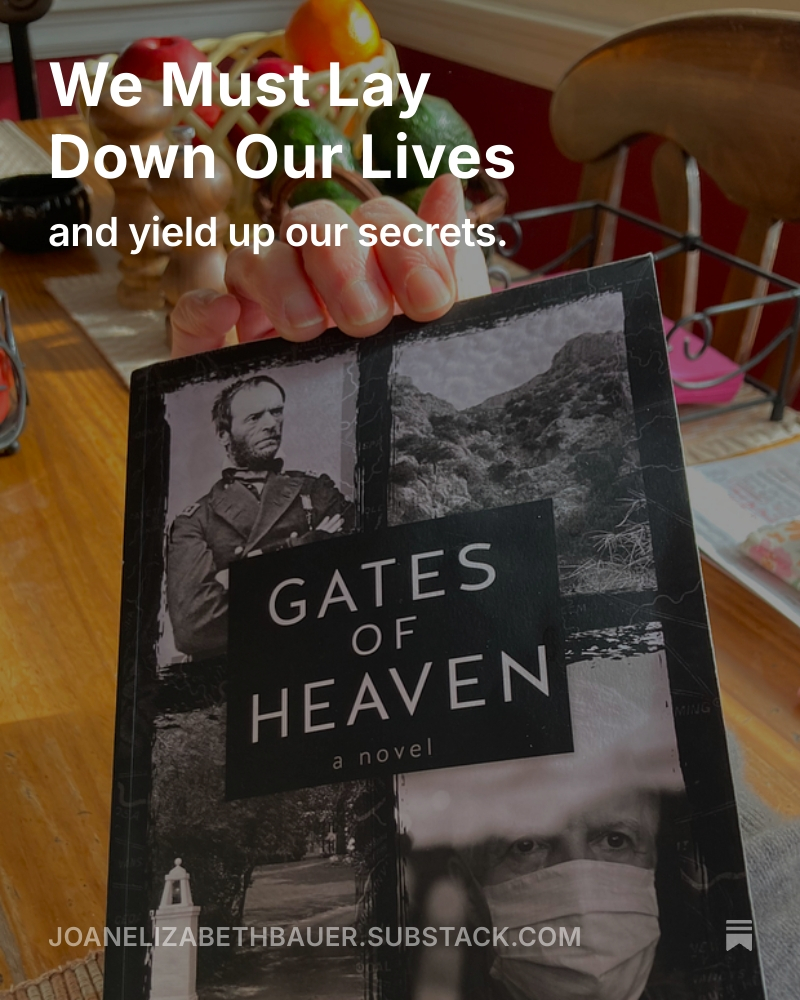
Glenn Arbery’s Gates of Heaven is many things: a story of Covid and demon possession; a portrait of America through the lens of small towns and road trips; an eruption of the past into the present akin to Beloved; a young man’s discovery of a prophetic writer’s vocation; and a study of a brutal, passionate man, Braxton Tecumseh Forrest, who tries to govern his family and friends like a wealthy old patriarch. Oh, and did I mention trauma, domestic disputes, exorcism, arson, the lure of a charismatic preacher, and shameful secrets—some of which stem from the story’s earlier installments? Gates of Heaven is a serious novel about serious subjects; but it’s full of the joys of a sprawling telenovela, where various storylines advance like kudzu while you wait to find out if your favorite character will ever wake up from that coma.

Karl Guizac is really the poet Walter Peach—both names are given to him ironically, and neither one reflects his actual parentage. Six years ago, Peach fled Gallatin, Georgia with his family after nearly ruining his life. Now safely ensconced at the foot of the Wind Mountains in De Smet, Wyoming, Peach is the genius behind Sage Grouse, a satiric semi-political online journal featuring the musings of one Socrates Johnson, a fictional Wyoming local who has his finger on the pulse of a nation in flux. But on the very day of the 2020 election, Peach succumbs to a severe case of Covid. He spends much of the novel in a medically induced coma, where he dreams that the accuser torments him before he faces the tribunal that will decide his eternal fate.

Ordinarily, our own sins and failings are more than enough to condemn us absent the mercy of God. But the seismic political shifts of 2020 have opened a portal attaching our rages to William Tecumseh Sherman’s rages, our infidelities to his. Like the puppeteer who occupies John Malkovich’s mind in the 1999 Spike Jonze film, Sherman slips figuratively into the twenty-first century via the dissociative mind of Jacob Guizac, born Buford Peach—a high school senior whose imaginative capacities are exceeded only by his bravery and goodness. As Walter Peach hovers between life and death, he becomes entangled somehow with his son Jacob’s Sherman obsession. Briefly awakened from his coma, Peach tells Jacob,

My soul. Is stitched. Onto his. Pray for me.

Peach’s dream trial, in which he must defend not only his own soul but that of the South’s most hated historical figure, enacts beautifully our present-day preoccupation with the social sins of our ancestors. Can we twenty-first-century people simply move on and try to live the best lives we can, or must we somehow atone for the sins of a past we never inhabited? What does it mean to live as members of the Body of Christ—a Body that stretches forward and backward in time?

Sensational though it might be, Gates of Heaven is deeply informed by the teachings of the Catholic church—which, when you think about it, can be quite sensational in themselves. Midway through the book, after a funeral gone horribly wrong, two people who consider themselves mighty unworthy are chosen to authorize baptism for a motherless child. In hearing their confessions beforehand, a priest tells one of them,

Believe that you have been forgiven. Your past is the story that the accuser can use to shake your faith. You’re no different than any of us. We have repented, and Christ has forgiven our sins. Though your sins be as scarlet, they shall be as white as snow.

How’s that for a sensational promise? When the two of them later advance to the baptismal font, they enact the forgiveness of a past sin of their own. We might call this a scandal of mercy, but only because it rings true.

In Arbery’s novels (I’ve read two of the three), everyone struggles with sin. Even the best male characters are tempted by their adoring (and much younger) female students, and their long-suffering wives must decide whether to offer forgiveness. Male barbarism wreaks havoc on young female bodies—Nora O’Hearn’s sufferings in the brutal but gorgeous Boundaries of Eden still trouble my mind—but in Gates of Heaven, a chorus of pregnant young women sings joyfully as they scrub down the smoke-infused walls of Stonewall Hill, the antebellum mansion where a pregnant slave was once chained in the basement. Would that we could wash history clean in this way.

In the end, Arbery’s rich novel points backward and forward, on multiple fronts, while still leaving us with a haunting suggestion or two. Oh, how I love an outlandish story like this—especially one with such a historical bent. Kudos to Arbery, too, for writing about the 2020 election and Covid without letting either huge elephant squash his story.

For this perishable must put on the imperishable, and this mortal must put on immortality. But when this perishable will have put on the imperishable, and this mortal will have put on immortality, then will come about the saying that is written, O Death, where is your victory? O Death, where is your sting? (1 Corinthians 15:53-55)

The “Wagers” of Sin is Death

Actually, make that murder.

Recent Reads

Dec 19, 2025

Last February, I joked that Milwaukee’s snow totals were finally catching up with Louisiana’s. Well, things have gone back to normal—we took our first hit of eight to ten inches on the Saturday after Thanksgiving. Most of that snow is still here*, plus whatever else has fallen since then (I confess I’ve lost track). The piles are slowly encroaching on usable driveway space, and the plow’s most recent leavings, now frozen solid, serve as makeshift speed bumps as we pull out onto the street.

But while winter has tightened its headlock a bit earlier than I expected, I haven’t really felt the need to escape. In fact, when we left town last week to attend our daughter’s college graduation in Florida, I worried about my unfinished Christmas shopping. A dear friend promised to drive by my house while I was gone and collect any packages that appeared at our front door—one of which spent a few days buried under the snow on our neighbors’ front porch, where they found it as they were shoveling on their return from a trip of their own. This is just normal, right? Why be a snowbird?

But the moment I stepped off that plane in Fort Myers, I understood. We shed extra layers under the palm trees, walked on the beach past the sandcastles of frolicking children, and ate ice cream outside after dark. We posed for graduation pictures under the bluest sky I’ve seen since September at least. Or maybe June. We’d landed in a meteorological sweet spot reminiscent of late spring, when the humidity hydrates you instead of oppressing.

Congratulations, Annie!

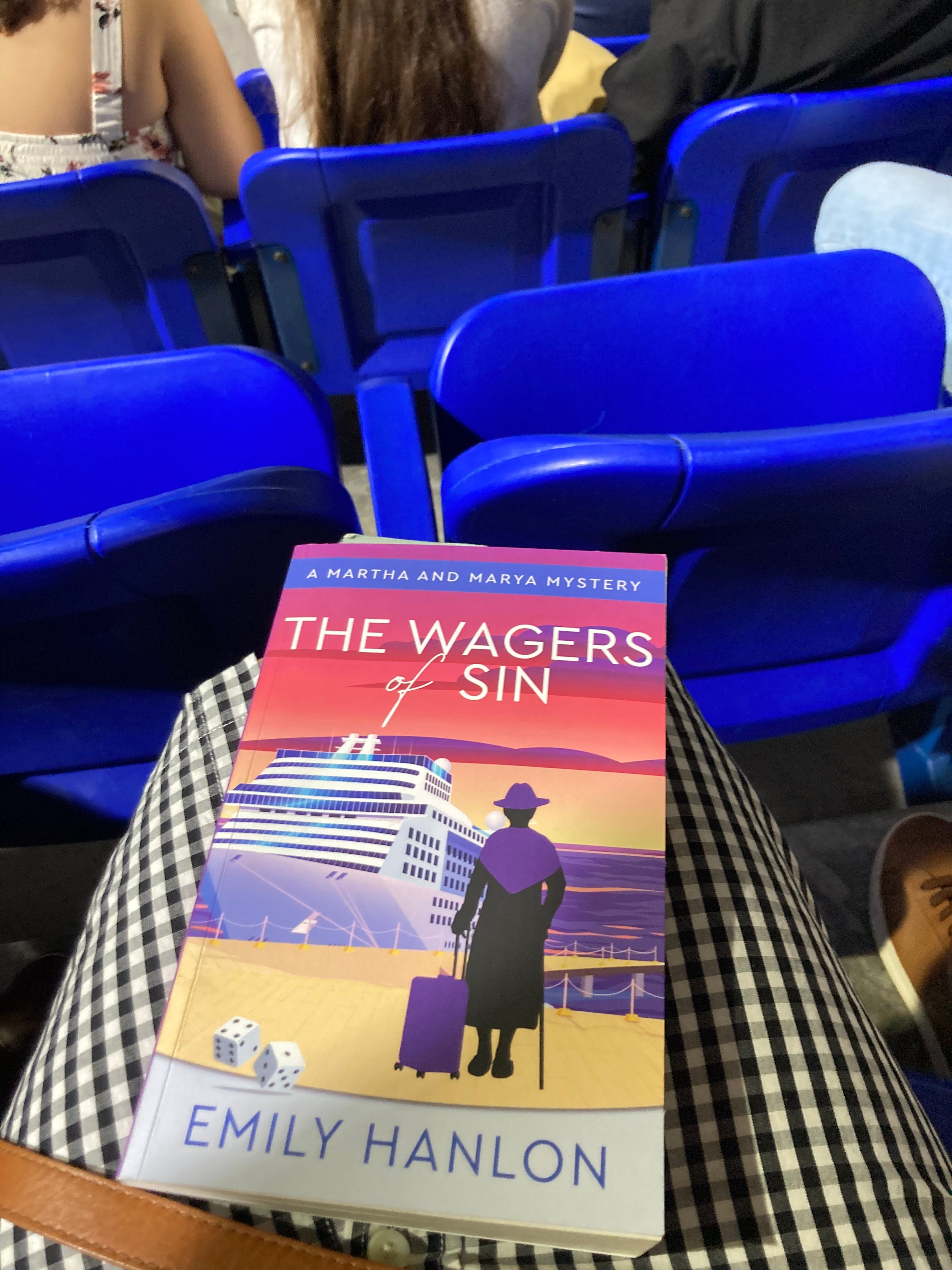
My husband and I brought books along to graduation because we’d had to drop our daughter off early. Before the ceremony, as two young women in long sequined dresses performed Ed Sheeran songs on the floor of the arena and pictures of smiling undergraduates cycled by on the jumbotron overhead, I was engrossed in the third installment of Emily Hanlon’s Martha and Marya mystery series, The Wagers of Sin. A young, handsome cruise ship employee was about to marry an elderly woman of enormous wealth. Helen Holmes, the octogenarian bride, had slumped in her wheelchair moments before pronouncing her vows when …

… the musicians cued Pomp and Circumstance, and several dignitaries began to process into the arena, followed by the graduates.

Darn it! I reluctantly put down the book just as Marya Cook—herself an elderly woman known locally as the “purple pest” —uses the word “murder” for the first time. Marya, who calls everyone “my dear” and quotes life lessons from a grade-school teacher named Sister Thomas More, commits occasional malapropisms while being a stickler for proper grammatical usage. Her friend Martha Collins tries to make ends meet as an Uber driver while running (without much hope of success) for lay commissioner of police. As you might expect, Martha is the more practical of the two. She is active in the Society of St. Vincent de Paul (we have that in common), and in lieu of swearing, she calls on an endless procession of little-known saints (“By the broken bones of Saint Sadoth, I am such an idiot”). Having successfully solved mysteries with Marya before, Martha follows Marya’s lead, though she rarely gets any credit.

The “wager” of the title is Pascal’s Wager, which states that believing in God is the most rational course of action when the potential benefits—eternal life in heaven—far outweigh the passing pleasures that belief asks us to sacrifice. Helen Holmes, who makes Marya’s acquaintance by shouting at her to get out of the way of her motorized wheelchair, stands much in need of reform at the story’s outset. Surrounded by greedy, grasping relatives, she plans to give most of her money away and enjoy the rest for whatever time she has left. Of course, someone out there has other plans. Will Helen’s wager pay off? And will the “purple pest” solve the crime before she runs out of tea and digestive biscuits?

This is a wonderfully funny book in which the characters are all marked by idiosyncratic bits of business. Whenever someone needs advice, Marya roots in her lilac and orange plaid bag for a laminated index card with an appropriate scripture quote. Two detectives who appear to be in love banter back and forth as to which era featured the most luminaries—the Middle Ages or the Renaissance. Martha’s opponent in the race for police commissioner plays dirty tricks, while a handsome childhood friend takes Martha’s side. I haven’t yet read the previous two entries in the series, but I had no trouble settling in. Emily Hanlon is a pro, and I highly recommend this funny Catholic read.

Unfortunately, all good things must come to an end, including delightful books and trips to Florida in December. Our flight home was delayed, and when we finally deplaned in Milwaukee well after midnight, I saw my breath in the jetway—the temperature had dropped to the low single digits. As we hurried coatless to our car in the parking garage, I understood what is meant by the phrase “piercing cold” in the St. Andrew novena. I’ve grown to love this little prayer as I say it over and over throughout the day:

Hail and blessed be the hour and moment in which the Son of God was born of the most pure Virgin Mary, at midnight, in Bethlehem, in the piercing cold. In that hour vouchsafe, I beseech Thee, O my God, to hear my prayer and grant my desires, through the merits of Our Savior Jesus Christ, and of His blessed Mother. Amen.

Come, Lord Jesus! A blessed Advent to all!

*As of this writing, a brief thaw and chilly rain have uncovered sections of grass and made the sidewalks so slippery as to be nearly impassable. The exhaust-blackened snow lining the streets is receding to reveal the last of November’s uncollected leaves. Ah, Milwaukee! We’ll hope for more snow.

The Payoff at the End

On the books I choose, and those that are chosen for me

Recent Reads

Nov 29, 2025

For years, I have chosen my books from my husband’s admittedly rarefied shelves. It was in his collection that I first discovered the worn-out volumes of Proust that I consumed over my lunch hour at work in my mid-twenties. This was right after graduate school, and I was struggling to adjust to my new secretarial job. One day, a man I didn’t know approached me in the employee cafeteria of our venerable Milwaukee bank, nodded at my book, and asked if I would recognize the bank president on sight. When I asked why, he informed me in all seriousness that reading was not allowed here in this cafeteria; employees were expected to socialize over lunch, and the formidable Mr. P. was known to drop in unannounced. I knew no one there with whom I might socialize, and I was too astonished to thank him for the warning. From that day, I ate my peanut butter sandwiches undisturbed with my book in Cathedral Square Park or at the Grand Avenue Mall.

It took me nine months to read all seven volumes of Proust; I bogged down along The Guermantes Way (book three)But the payoff at the end of that volume—when the Duc de Guermantes howls at the Duchesse to go inside and change into her red shoes at a critical moment—was worth every political disquisition I had to slog through. Around that same time, I consumed volumes of Balzac and Flaubert, Eliot and Gaskell, Brontë and Collins, Wharton and James, along with Wallace Stegner and Norman Maclean (it was the nineties). By the time we had children, my reading expanded in all sorts of beautiful ways: Beatrix Potter and A.A. Milne, Virginia Lee Burton and Johnny Gruelle, Richard Scarry and Eric Carle… you know the list.

But then reading turned social.

My husband says he could never join a book club—at any given time, he’s already working his way through some two dozen titles. And I almost said no when a group of my oldest friends invited me to join their book club in the early 2000s, because I cherished my unfettered reading habits too much. One founding member called and insisted that they didn’t want to do it without me, so I said yes. And I didn’t regret it. We spent many lovely evenings at book club together, and when she died in 2009 after a long illness, I asked her in my heart to take my intentions with her to heaven. May she rest in peace.

Book clubs have taught me a lot about surrender. There’s an element of sacrifice, even abandonment in committing to ten or twelve titles a year that others will chose; at an average of ten hours a book, that’s at least one hundred hours of “spoken-for” reading. Many of these books have been gems that I wouldn’t have found otherwise; I first read Kurt Vonnegut and Lois Lowry, Kristen Hannah and Anthony Doerr as book club selections. Even the books that I didn’t enjoy have taught me a lot about craft. Still, I’ll never get back the time I spent reading that singsong-y book about the mother who cuts huge swathes out of the map as impossible places to raise her dysphoric child—the one whose counselor bounces on an exercise ball and talks just like Pee Wee Herman. And I feel sorrowful when I can’t jump into a highly anticipated book because I’ve committed to reading something else for a book club.

So, why do I do it? Am I just looking for social connection—or is there something profound in setting aside my self-will and accepting the preference of another? A book that is chosen for me might be a gift, or it might be a cross that I need to accept; it might be an occasion for discipline, or an instance of “Thy will be done.” When I was younger, I roamed freely over the shelves, pleasing myself. Now, when I read a book that is chosen for me, I am pleasing another—perhaps even serving her, if together we can enjoy the book more or perhaps notice the dangers it might present. Mostly, in reading and talking about it with her, I am giving myself. That’s important to do when my natural impulse is to turn away from conversation in favor of reading. There is something unhealthy for me in being left to my own devices—literal and figurative—for too long.

And so, I can sorrow over all the things I haven’t read, or I can take delight in the book I am reading right now; I can try to compete with the person who’s read more than me, or I can profit from their careful reading of a text I do not know; I can hoard my own choices, or I can humbly accept a recommendation from someone as an offering of their inner life, an invitation to share something they have enjoyed. And I do believe that certain books rise to the top of the pile when God wants us to read them.

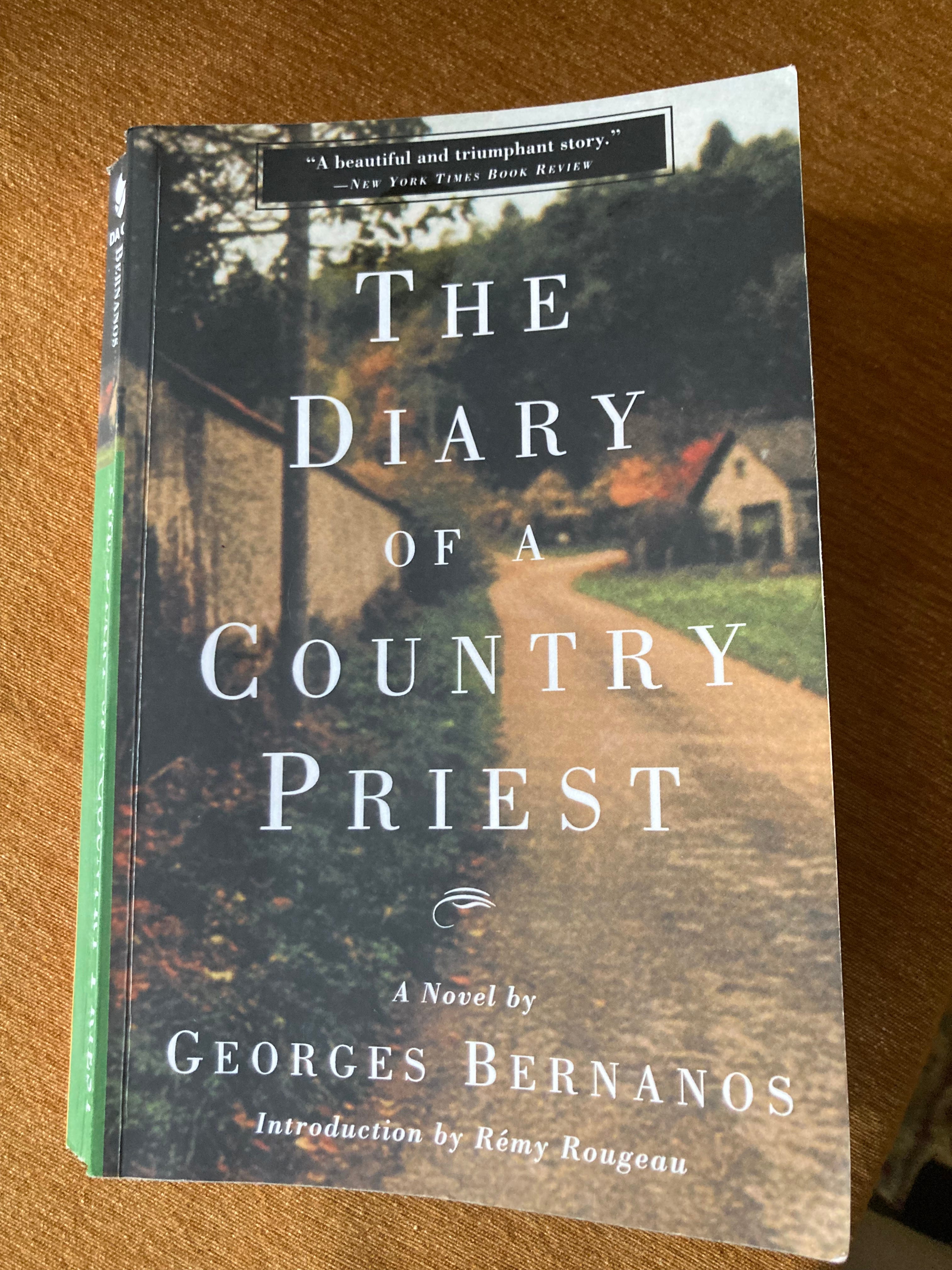
I had added George Bernanos’s The Diary of a Country Priest to my list at least three years ago, but when Dana Gioia mentioned in a podcast that certain critical passages had been restored in the 2002 edition, I was eager to start. Turns out, my husband had purchased the most recent edition earlier in the summer and was already partway through. (I can’t always keep track of what’s in those rotating stacks of his.) I had to wait my turn before we could start our own two-person discussion, but the payoff was every bit as wonderful as he promised it would be.

Early on, the unnamed young country priest of the title recalls his exposure to vice as a lonely, neglected child. He turns fruitfully to Russian literature for solace, particularly Maxim Gorky’s My Childhood:

There’s some of everything in it, as they say. The howling of a moujik under the rods, the screaming of a beaten wife, the hiccup of a drunkard, and the growlings of animal joy, that wild sigh from the loins—since, alas! Poverty and lust seek each other out and call to each other in the darkness like two famished beasts. No doubt I should turn from all this in disgust. And yet I feel that such distress, distress that has forgotten even its name, that has ceased to reason or to hope, that lays its tortured head at random, will awaken one day on the shoulder of Jesus Christ.

What a beautiful and hard-won depiction of divine mercy! The young priest carries deep wounds of abandonment and premature awareness of sin without sacrificing purity of heart; this rare combination wins him pastoral success, but at the steep social price of widespread condemnation. The text can be cryptic, as diaries are. I read some pages over and over just to get the plain sense of them. But the voice of the young priest quickly enthralled me. His strange diet of dry bread and warm, sugared wine leaves him indebted to unscrupulous tradespeople and subjects him to charges of drunkenness; his perhaps ill-advised tête- à-têtes with troubled young women—girls, really, who exhibit sophistication beyond their years—expose him to vilification by those whose consciences need to be pricked. He makes a pilgrimage of his prayer life, crossing vast deserts of dryness while bravely and tenderly admonishing sinners. This particular passage recalls Gertud von le Fort’s Song at the Scaffold, in which the fearful young novice Blanche de la Force takes the name “Jésus au Jardin de l’Agonie:

Isn’t it enough that Our Lord this day should have granted me, through the lips of my old teacher, the revelation that I am never to be torn from that eternal place chosen for me—that I remain the prisoner of His Agony in the Garden. Who would have taken such an honor upon himself?

In the end, the young priest arrives at a pitch of forgiveness and renunciation worthy of any saint. The trouble with his life, he says, is that “there was no old man in me, ” and thus he has “loved without guile:”

And so I find great joy in thinking that much of the blame, which sometimes hurt me, arose from a common ignorance of my true destiny.

Of course, I can’t tell you about the payoff without spoiling the book, but it’s definitely worth it. “Grace is everywhere,” the young priest says. Even—perhaps especially—in a book someone else has chosen for me to read.

***

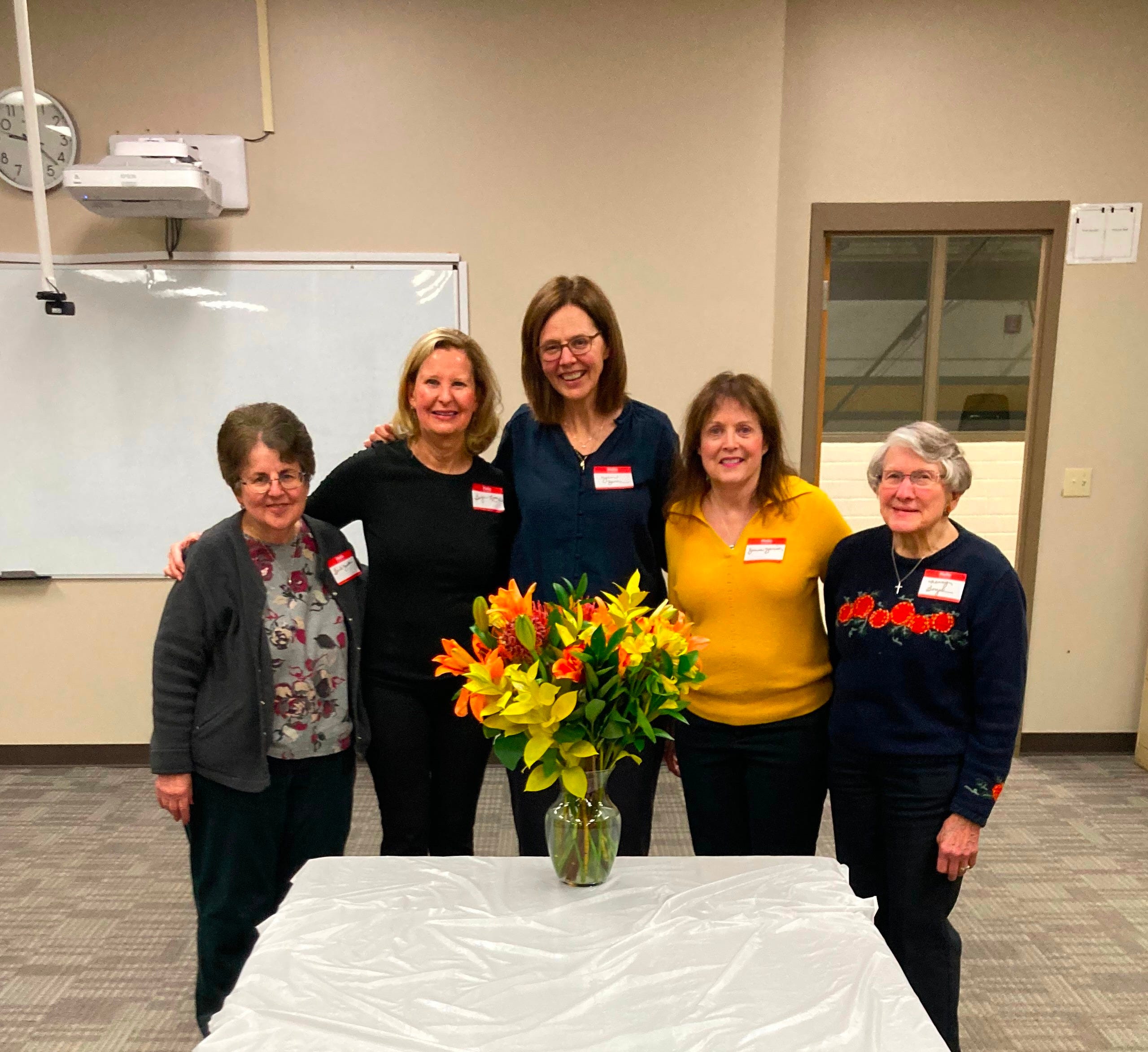
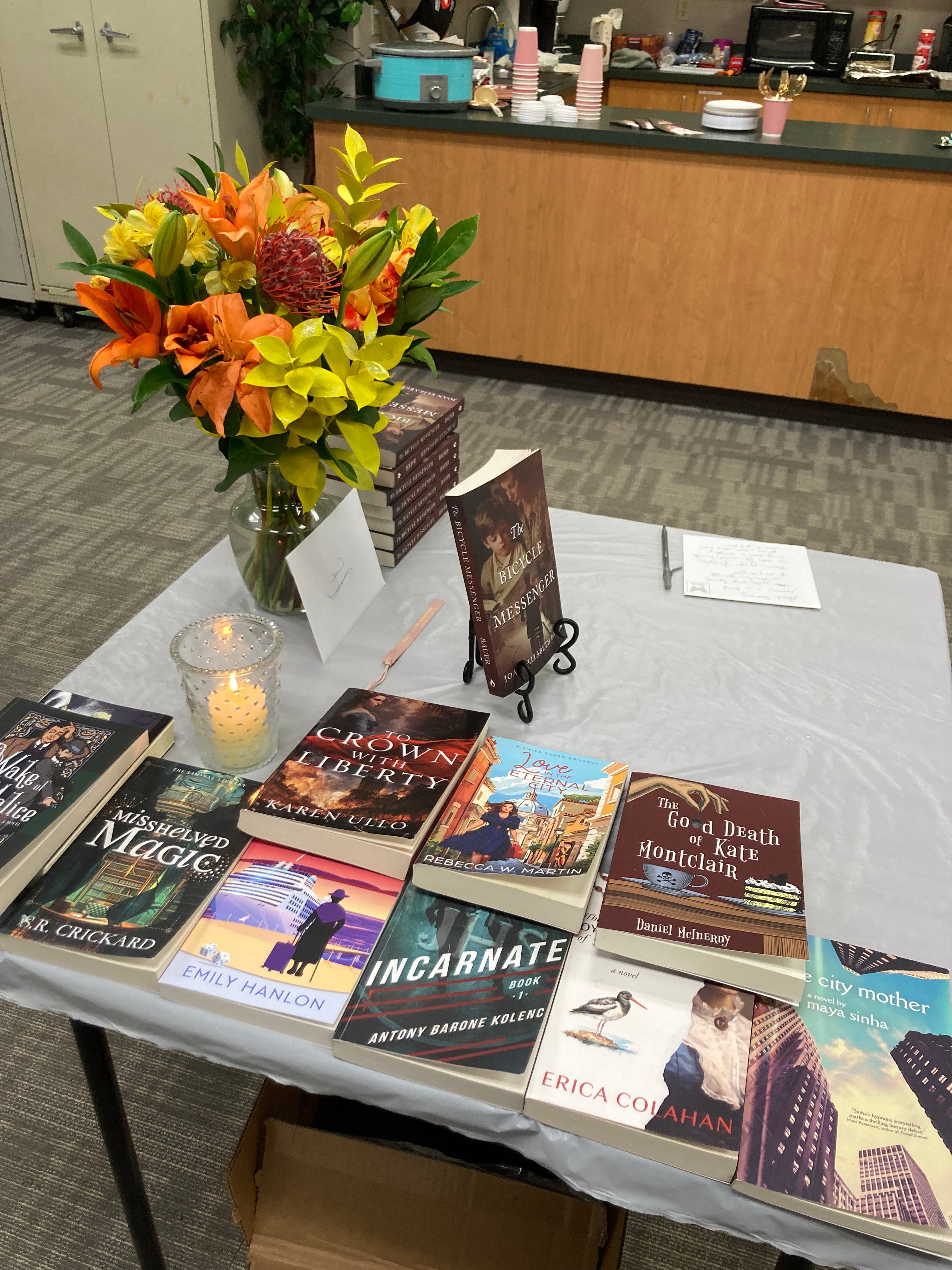
In other news, I had a wonderful time speaking to the Women of St. Jude on Tuesday, November 11 about my journey to publication. The delightful ladies pictured here created such a generous and hospitable atmosphere for all of us, complete with cider, charcuterie, and homemade desserts. In addition to reading from The Bicycle Messenger, I brought a number of Chrism Press titles for “show and tell.” As you can see, my collection is growing—my copies of the first two Molly Chase books are on loan, so they are not pictured. Everyone was very interested in the array of good Catholic fiction on offer.

I was also very pleased to learn that The Bicycle Messenger received the Seal of Approval from the Catholic Writers Guild. This designation assures Catholic readers and booksellers that the book will not offend their faith and that it is appropriate to promote in a Catholic setting. Thank you to the dedicated reviewers who provide this service through the Guild!

Bells are Ringing

Back to Basics
Recent Reads

Oct 27, 2025

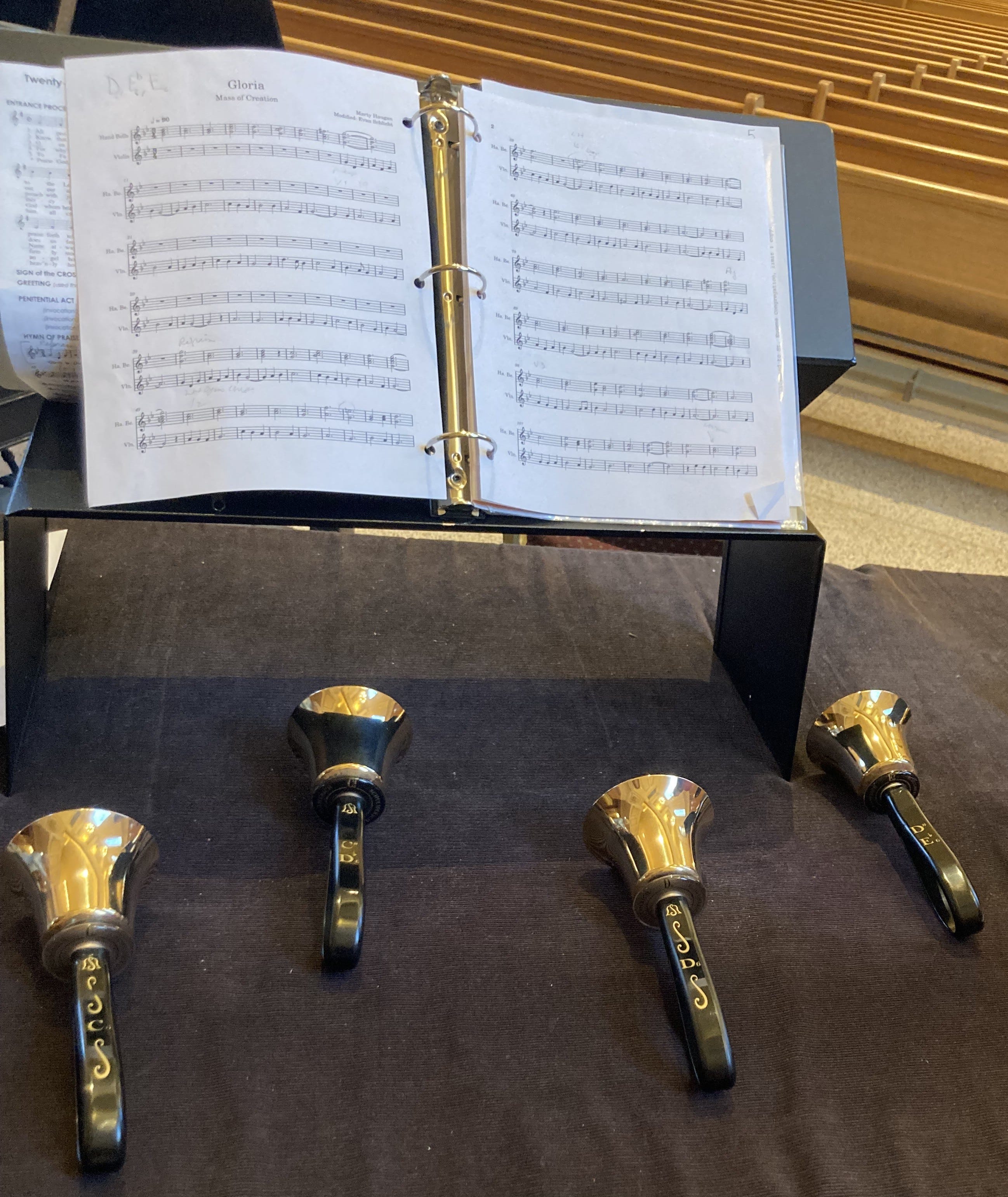
I can’t tell you how happy I am that our new Director of Music has reinstituted the handbell choir at our parish! As you may remember, I was crushed when our former director took a new job last spring, prematurely ending our season. And while some of us made the decision not to continue (a few people were traveling long distances from other parishes), we are now a group of four and hopefully growing.

Everything looks very different from this new perch. We’re getting back to basics on our musical skills, and this has been a real exercise in humility for me. There’s no fancy knocking with two bells in one hand for me now—and no pieces without piano accompaniment just yet, a great blessing when you consider how easy it is to wander off the rails a cappella. Because of our numbers, Evan has also devised new arrangements, wisely opting in favor of accuracy by assigning us just two bells each, with perhaps an accidental or two.

As a choir director, Evan is like a kind shepherd—if he was expecting a more talented flock, he hasn’t let on. (I speak only for myself here, as I have lately rediscovered my true weakness as a liturgical musician.) Rather, he immediately assumed a lot of duties we used to do for ourselves. Everything in my book is lined up according to its position in the order of worship, and my bells are all marked for me at the top of my page. Before we play a single note, he calls our attention to the neat little octave of bells we are using for each piece. There is a satisfying logic to the way he has us practice the pieces that are in the same key before we move on to a different one. And when he had us play through the entire liturgy before we returned to drill our mistakes, he even asked us to be quiet as we transitioned our bells, just as we will do at mass.

Though it looks easy, playing in a handbell choir is a cognitive challenge for me. Cues come up quickly, and it’s easy to miss them (I’m just hoping to improve neuroplasticity here). When I first started, I remember feeling like Lucy and Ethel on the assembly line, eating chocolates as they went by because I’d failed to deposit them in the boxes correctly. Even now, I’m often appalled at how much I’ve forgotten at practice since the previous week. Sometimes I play as though I’ve never seen the piece before! But even my worst mistakes bring only an offer of help. While serving as both director and accompanist, Evan conducts with facial expressions and gestures; and when I failed to come in on time after a transition, he kindly asked me if he wasn’t nodding firmly enough. Oh, dear! If I had only looked up, I would certainly have seen him nodding. But I was too busy looking for the D sharp I had to play next. So, Evan adapted the score, putting in a quarter rest to give me more time to transition. It’s so wonderful to see humility in action like that.

It was raining when we reported for warmup at seven-thirty on Sunday morning. Evan had brought the entire liturgical music operation, including the cantor, down to the piano on the main floor in the back of church where our handbell tables are located. For our sake, the congregation fasted that day not only from the organ but from a mic on the piano and even from the proclamation of the psalm in the ambo. We were cozy in back on that rainy morning; attendance was rather light, as the forecast was due to improve before the next mass. But this gave Bonnie, our cantor and an experienced music educator, a chance to encourage us as we ran through our pieces. Somehow, I got totally flustered during practice. But I was determined that my most disastrous mistakes would not follow me into the mass, and somehow, they didn’t. Sure, I missed a few notes. But I didn’t get lost, and I didn’t play that D sharp at the wrong time. Perhaps Evan was pleasantly surprised. He was probably praying for us, because he seems like that kind of person. How grateful we are.

It’s a Secret

Why I can’t tell you what I’m reading this month

Recent Reads

Sep 29, 2025

Okay, I can tell you some of what I’ve been reading this past month or so:

Brant Pitre’s Jesus and the Jewish Roots of Mary, for a wonderful explication of the ways Mary fulfills the types and patterns of the Old Testament, always pointing to Jesus;

Thanks for reading! Subscribe for free to receive new posts and support my work.

Sigrid Undset’s biography of Catherine of Siena, for a glimpse of the action of God through the eyes of a passionate mystic; and

White Week and Other Stories, a beautiful collection by Wojciech Chmielewski that appears for the first time in English thanks to a collaboration between the Polish Book Institute and Wiseblood Books. With its sorrowful character sketches, its haunting wartime dislocations, and its mystical relationship to time, Chmielewski’s book reminds me of everything I love about W. G. Sebald. One story, “Deventer,” refers directly to Sebald’s The Rings of Saturn; a man named Kacper dips backward into a life lived centuries ago among a group of monks who transcribe books and sew shoes. This enigmatic character also recalls Gaustine from Georgi Gospodinov’s Time Shelter, which won the International Booker Prize in 2023. (You can read more about Time Shelter here.)

So, yes, I’ve been reading lots of interesting books. But the book I’ve read the most closely this month? The one that’s generated pages and pages of notes? The one I’ve agonized about getting just right? Can’t tell you. And, no, I’m not finishing a long-delayed dissertation. I never even began one.

The reason I can’t tell you is that the book is part of a proprietary reading list that won’t be revealed to group members (some 13,000 of them around the country) until next summer. This month, I’m preparing an entry for the 2026 Well-Read Mom Reading Companion—a wonderful resource that rivals any undergraduate English textbook I’ve ever used. I’ve belonged to a Well-Read Mom group for a few years now, and I can’t say enough good things about this wide-ranging Catholic book club to help women “Read More and Read Well.” So, while I can’t tell you anything about the book I’ve been reading, I can say that it’s a wonderful choice. And since this current year of Well-Read Mom is just beginning, there’s still time to join a group or start one of your own.

Speaking of book clubs, my Well-Read Mom group did me the great kindness of reading The Bicycle Messenger in September. Thank you, ladies! I learned so much from our discussion! A few of our members work directly with people who suffer from mental health conditions similar to the one that affects Steven Hawley in the book. Others had been to Poland on a recent pilgrimage with former Milwaukee Archbishop (now Archbishop emeritus) Jerome Listecki. Still others shared their own family experiences with mental health and adoption. I learned that one of my narrators, Mary Ellen Hawley, managed to “fracture the family” through her attempts at control—though others rose to defend Mary Ellen for taking a leap of love. In other words, everyone was very engaged. One of the best things about publishing a novel is that I finally get to show my friends and family what I’ve been doing all this time. Any anxiety I had about people who know me reading the book has been transformed into the joy of receiving their reactions. What a gift.

Finally, for Milwaukee-area friends, I’ll be reading from The Bicycle Messenger on November 11 at 6:30 p.m. at St. Jude the Apostle Parish in Wauwatosa. More information is yet to come, but many thanks to Fr. Justin Weber and to the Women of St. Jude for agreeing to host me.

A Power Made Perfect in Weakness

The Song at the Scaffold and Little Souls

Recent Reads

Aug 29, 2025

Sometimes, everything I happen to read—novels, essays, and spiritual books—seems to coalesce around a particular theme. In a matter of weeks, I encountered the Carmelites of Compiègne, who were martyred during the Reign of Terror, in three different places.

In his do-it-yourself retreat entitled Consoling the Heart of Jesus, Father Michael E. Gaitley tells the story of certain “super-nuns” of the Carmelite order who asked God to lay on them the punishment due to poor sinners as an offering to His Divine Justice. “Amazingly,” Father Gaitley writes, “the Lord accepted such deals.” These “big souls” would then fall ill and/or suffer greatly, offering their pains to God for the sinners’ conversion. Gaitley goes on to quote St. Thérèse of Lisieux’s mic-drop response more than a century later:

This offering seemed great and very generous to me, but I was far from feeling attracted to making it.

Wow. If a great Carmelite saint like Thérèse could feel this way, perhaps there is hope for a lover of comfort like me! St. Thérèse suffered much from her illness during her short life. But instead of making this offering to Divine Justice, she chose the soaringly beautiful Offering to Merciful Love, which is found in The Story of a Soul and quoted by Father Gaitley:

If Your Justice loves to release itself, this Justice which extends only over the earth, how much more does Your Merciful Love desire to set souls on fire since Your Mercy reaches to the heavens? O my Jesus, let me be this happy victim; consume Your holocaust with the fire of Your Divine Love! (emphasis in original).

I find this very consoling. As I have written before, certain offerings naturally fit our charisms better than others. To me, the Offering to Merciful Love feels like a much easier yoke to carry.

The Song at the Scaffold by Gertrud von Le Fort made me reflect on what it means to be a “little soul” after the example of St. Thérèse of Lisieux. In this short novel, Blanche de la Force is born early after her pregnant mother is dragged from her carriage when her panicked horse plunges into a crowd. This omen casts a long shadow over Blanche: “the great fear in her childish gaze penetrated the firm exterior of a sheltered life to a core of terrible frailty.” Blanche seeks constant reassurance that the very stairs of her home will not collapse under her feet. And while Blanche finds protectors and guides in the Carmelite order, she will never be entirely free of her fear. Her novice mistress, Sister Marie, will eventually say,

“Must fear and horror always be evil? Is it not possible that they may be deeper than courage, something that corresponds far more to the reality of things, to the terrors of the world, and to our own weakness?”

Sister Marie is herself a “great soul,” the natural daughter of a prince who longs to die as a martyr for the salvation of France. But while Sister Marie fears that her offering has been rejected by God, Blanche’s name in religion, “Jésus au Jardin de l’Agonie,” unites her to Christ’s mortal dread in the garden of Gethsemane. Blanche’s story calls to mind St. Paul’s second letter to the Corinthians, where he begs the Lord to remove a thorn from his side: “And He has said to me, ‘My grace is sufficient for you, for power is perfected in weakness.’” In her weakness and littleness, Blanche epitomizes the “little way” of Saint Thérèse de Lisieux.

In the end, even the “great souls” of the Carmelite order must abandon themselves to whatever use God will choose to make of their sacrifice. In his recent essay marking the feast of the newly canonized Carmelites of Compiègne, Donald Jacob Uitvlegt offers this interpretation:

Ten days after the martyrdom, the Reign of Terror came to an end with the execution of Robespierre on July 28, 1794. Though the struggle of the Church in France was by no means over, one wonders if the blood of the martyrs again was the seed of the Church, for in the nineteenth century, one finds such glories in French Catholicism as St Jean Vianney, St Bernadette Soubirous, St Théophane Vénard, and St Thérèse of Lisieux.

Mic drop, indeed. Holy Carmelite martyrs of Compiègne and Saint Thérèse of Lisieux, pray for us!

For Book Clubs

Discussion Questions for The Bicycle Messenger

Recent Reads

Aug 15, 2025

Please pray for all those who have been impacted by flash flooding in southeastern Wisconsin and for everyone involved in the recovery effort.

We had a wonderful time launching The Bicycle Messenger at the Village Cheese Shop here in Wauwatosa on August 3. If you’ve found time to open the book in these last days of summer, THANK YOU! If you are considering reading The Bicycle Messenger with your book club, I’ve compiled a few questions that might help guide your discussion.

Reading Group Discussion Questions for The Bicycle Messenger

1. The story is narrated by three people: Steven’s adoptive mother Mary Ellen, his girlfriend Megan, and his sister Margaret. Which of these characters did you identify with the most? Did any of them frustrate you with her actions or her omissions?

2. At the beginning of the story, Mary Ellen keeps her bank account secret from her husband. Later, Megan keeps her own plans secret from Steven. Is it ever appropriate to keep secrets? How does a lack of candor distort the relationships between the characters?

3. The Holocaust represents an extreme case of xenophobia, or the hatred of strangers. Fear of mental illness in others could also be considered xenophobia. Do you see this fear playing out in Steven’s relationships? Did your view of Beatrycze, Steven’s birth mother, change over the course of your reading?

4. How are we called to accompany people dealing with mental illness and/or past trauma? Which characters best exemplify a compassionate response?

5. Three different characters are faced with unexpected pregnancy in the story, and each one makes, or at least contemplates, a different decision. How do the other characters support or hinder them in choosing life for their children? Can you imagine ways to more effectively empower women to choose life, whatever their circumstances?

6. Near the end of her life, Mary Ellen tells Margaret that “The only trouble [with adoption] is, in order for you to receive a child, some other poor woman has to let one go.” What are your experiences surrounding adoption? How have our attitudes and practices regarding adoption changed over the years?

7. Have you ever experienced estrangement from family or friends? If you were able to resolve it, how did it happen?

8. As a child, Steven is fascinated with the family’s grandfather clock. Later, Mary Ellen refers to the cycles of Steven’s mental illness as the “seven-year dread.” How is time addressed in the novel? What portents or healings do you see playing out? Have you ever had the opportunity to right a past wrong or console an old hurt?

9. Margaret rescues Steven’s mementoes when he suffers a manic episode. “In Margaret’s mind, keeping the book and the shoebox herself was an act of conservation, even a bulwark against his delusions.” Most families have one person who organizes events, memorabilia, and family stories. Who is that person in your family, and how did they get this role? Does it weigh lightly or heavily on them?

10. The story’s dénouement turns on an act of reading. Are there any books, letters, or newspaper articles that have brought healing or understanding into your life?

If other questions occur to you as you are reading, please share them in the comments! I’d love to hear what resonates and what sparks the liveliest discussions. Most of all, thank you for reading and sharing the book. It means the world to me.

On Baptism and Cultural Memory

One more sneak peek at The Bicycle Messenger

Recent Reads

Aug 01, 2025

It’s almost here! The Bicycle Messenger releases in just a few days! I can’t wait to share it with you. In the meantime, here are three takes on baptism in the story.

  1. Seven-year-old Steven Hawley is conditionally baptized because no one can locate his baptismal record. For the rest of his life, Steven wonders whether his baptism really “counts.”
  2. Steven’s mother agonizes in her uncertainty as to whether her grandson, who died in infancy, was ever baptized. Will she meet him in heaven, or will he spend eternity in limbo? Where is God’s mercy in this?
  3. In 1942, a Catholic priest proposes to rescue a Jewish child from the Kraków ghetto in Nazi-occupied Poland. Speaking to the child’s devout Jewish grandfather, the priest says, “if we do not baptize them, they will never survive. They must believe themselves to be Christians if they are ever to pass outside these walls.”

A few words on the Catholic Church in the Nazi Era

In her hauntingly beautiful novel of a young Catholic girl who perished in Auschwitz, author Lily Tuck cites Ronald Modras on the state of Catholicism in Nazi-occupied Poland:

During the German occupation, the Polish Catholic Church was in disorder. The Germans killed several thousand priests. In Rome, Pope Pius XII offered little support, instead advocating compromise with Germany. The Polish primate, Cardinal Hlond, had left Poland and had taken refuge in a Benedictine abbey in Savoy, France, and did not offer spiritual aid to his parishioners. Instead, in a 1936 pastoral letter, Cardinal Hlond wrote condemning the Jews: “It is a fact that Jews are waging war against the Catholic Church, that they are steeped in free-thinking, and constitute the vanguard of atheism, the Bolshevik movement, and revolutionary activity. It is a fact that Jews have a corruptive influence on morals and that their publishing houses are spreading pornography. It is true that Jews are perpetrating fraud, practicing usury, and dealing in prostitution.” (56-57)

These are painful words to read. They do not anticipate that a future great saint and Polish pope will undergo his priestly formation in secret under Nazi occupation; they do not anticipate that St. Maximilian Kolbe, arrested shortly after receiving his brilliant insight into Mary’s announcement at Lourdes—I am the Immaculate Conception—will serve the prisoners of Auschwitz faithfully and in secret as priest and confessor, ultimately offering his own life in exchange for that of a man condemned to the starvation bunker.

But while individual members of the church are prone to sin, the truth of the Catholic faith springs from the person of Jesus Christ. As Thomas Merton writes in New Seeds of Contemplation,

the living Tradition of Catholicism is like the breath of a physical body. It renews life by repelling stagnation. It is a constant, quiet, peaceful revolution against death. … only a gift of God can teach us the difference between the dry outer crust of formality which the Church sometimes acquires from the human natures that compose it, and the living inner current of Divine Life which is the only real Catholic tradition.

Getting back to the question of baptism

As I have noted before, there were many acts of specifically Catholic witness during the Holocaust. In her 1986 book When Light Pierced the Darkness: Christian Rescue of Jews in Nazi-Occupied Poland, Nechama Tec takes a scientific approach to such acts, collating data from numerous personal interviews in order to arrive at a realistic picture of the often-fraught relationship between rescuers and survivors. She tells of one devout Catholic Pole who struggled to reconcile his compassionate impulses with the anti-Semitic sermons he was hearing in church: “‘I am sure to lose both worlds. They will kill me for keeping Jews and then I will lose heaven for helping Jews.’” (146)

Tec makes it clear that not all rescuers intended to rescue anyone; many had their Jewish charges thrust upon them, one way or another. But for members of religious orders or the clergy who set out to rescue Jewish children, the question of baptism takes on cultural and spiritual urgency.

Were Jewish children baptized and saved because the Church wanted converts? Or were these children raised as Catholics because this gave them a better chance to stay alive?

Or both?

In other words, did we baptize them in order to save them — or did we baptize them in order to save them?

While admitting that children accepted into a Catholic institution were baptized, Dunski [a devout Catholic rescuer] said that this was done for safety. By becoming baptized[,] Jewish children saw themselves as Christian and therefore could more easily adjust to their new identity. … Young survivors I interviewed mentioned the comforting and soothing effect that the Catholic religion had upon them. … [T]here are many cases on record showing reluctance to baptize these children without the permission of their Jewish guardians. (141-142)

In writing The Bicycle Messenger, I was intensely drawn to the conflict within the soul of a man who knows that the only way to save a child in his care is to offer her into the hands of a priest whose creed he does not understand. As for the child’s mother—well, if you want her side of the story, you’ll have to read the book.