The gift keeps unfolding.
May 04, 2026
Publishing a novel after years of writing in secret has unlocked the joys of heartfelt responses from friends. People who never knew that side of me have taken the time to read, ask questions, and share their delight. And while I’m so grateful for their kind words, I still experience a moment of terror at being found out.
A week or so ago, my husband Paul and I had the most extraordinary conversation with Ira, who was the best man at our wedding. Paul and Ira became friends in graduate school at Duke in the mid-eighties; Paul studied English, while Ira earned a Ph.D. in Mechanical Engineering. Ira once asked Paul to make him a list of the one hundred greatest novels ever written, and he eventually read them all. He’s read all of my husband’s books, too.
Ira now lives in Paris with his family, and while I’m always delighted to see him, I’m happy to take a back seat while he and Paul talk. When Ira brought his French wife and daughter to visit us in Milwaukee several years ago, I was so nervous about cooking for them that I ended up making a family-style meal from my childhood: casserole and Jell-o. I felt like a rube, but we had a great time.
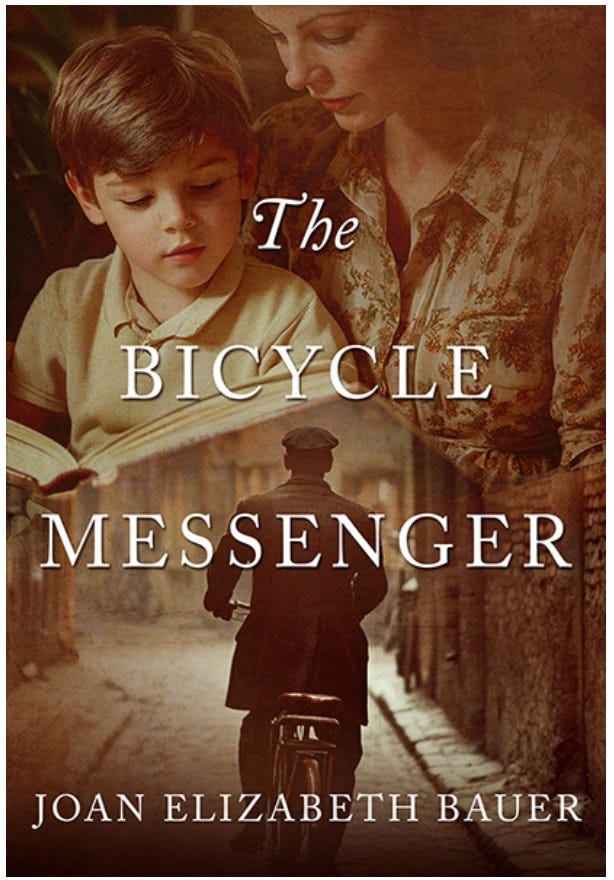
During an annual birthday call earlier this month, Paul mentioned my book to Ira as he was recounting the highlights of our family’s year. That was barely two weeks ago, so when Paul told me that Ira now wanted to talk to me over FaceTime, I didn’t know what to expect. The Bicycle Messenger tells the story of a family dealing with a loved one’s mental illness. And while the circumstances are fictional, Ira’s own memoir on the subject, co-written with his now-deceased brother Stan, is listed in the acknowledgements. Even so, I’d never told Ira just how much his relationship with his brother, who suffered from bipolar disorder, had inspired me.
My hair was still wet from the shower, poised to spring into random waves as it dried, but oh, well. I had to face the music, ready or not. Don’t worry, my husband promised as he got ready to dial the call. Ira said he couldn’t put it down!
And of course, Ira graciously set me at ease. He was touched to find his name right next to Roman Polanski’s* in the acknowledgements, because he’d had absolutely no idea what the book was about. And since he read it on Kindle, he didn’t even consult the back-cover copy. But as the story unfolded, he started asking himself, did she know about Stan? I jokingly apologized for that possibly unwelcome surprise; but Ira assured me that while the book brought back memories, they didn’t unfold in a painful way. He himself had never considered processing these experiences through fiction.
In the story, as Steven turns manic, his girlfriend Megan begins to fear him, and Ira acknowledged how realistic that was. Like Steven, Ira’s brother was always kind and would never hurt anyone. But he would start to look and act crazy, and some of his professional colleagues were ready to throw him away because of his illness, particularly if they had no significant prior relationship with him. And like Steven’s family members in the book, Ira never knew when he would be called upon to assist in a crisis. He described getting a phone call about Stan just as he was walking into a Final Four game the year Duke won a national championship. That was the only time he and his friends managed to get Stan the medical help he needed in the moment. No one really knows what to do in those circumstances, he said—so, no recriminations.
One particular story of Ira’s has fascinated me for years. Long before cell phones, Ira had to pursue his brother on a sudden, delusional trip to Hawaii. Once Ira had settled in and contacted local authorities, he had time on his hands, so he played a round of golf on a beautiful course while he waited for news. This idea absolutely confounded me; I couldn’t imagine having the presence of mind to play golf in the midst of that crisis. When I eventually wrote the scene in which Steven takes off for Poland in the hallucinatory belief that a long-lost family member has contacted him, I relied on my own experiences as a parent to help me to imagine his mother’s anxiety as she and her husband travel to Europe to search for their son.
I’d long known that Ira converted to Catholicism in graduate school, but we’ve rarely spoken of it except to acknowledge that his example influenced my husband. But now, Ira described how he’d leaned on his faith during those difficult times with Stan. His mother had lacked that support, since she was not a believer; whenever Stan would disappear suddenly, she would say it was as though her son were already dead.
By this point, a conversation that began in trepidation had turned spiritual. I told Ira that I always thought what he did for Stan was heroic. Ira replied that he didn’t think there was anything heroic about it. That just goes to show how little he thought to boast of his efforts to help a brother whose illness inexplicably robbed him of the fruits of his many intellectual gifts. Ira sacrificed his own comforts and plans for years for his brother Stan. And while I created very different characters and circumstances for my novel, I did my best to translate Ira’s faithfulness into my story. The Bicycle Messenger is my homage to this kind of sacrificial, self-giving love.
“Bravo,” Ira said at last, and as the conversation moved on, I settled comfortably into the back seat again. But I knew I would be unwrapping this gift for a while.
* As a child, Roman Polanski lived for a time in the Krakow ghetto in Poland, and I consulted his memoir in crafting some of the book’s historical scenes.
 Joan Elizabeth Bauer