Is it Nostalgia?

On novel-writing and obedience.

Recent Reads

Feb 20, 2025

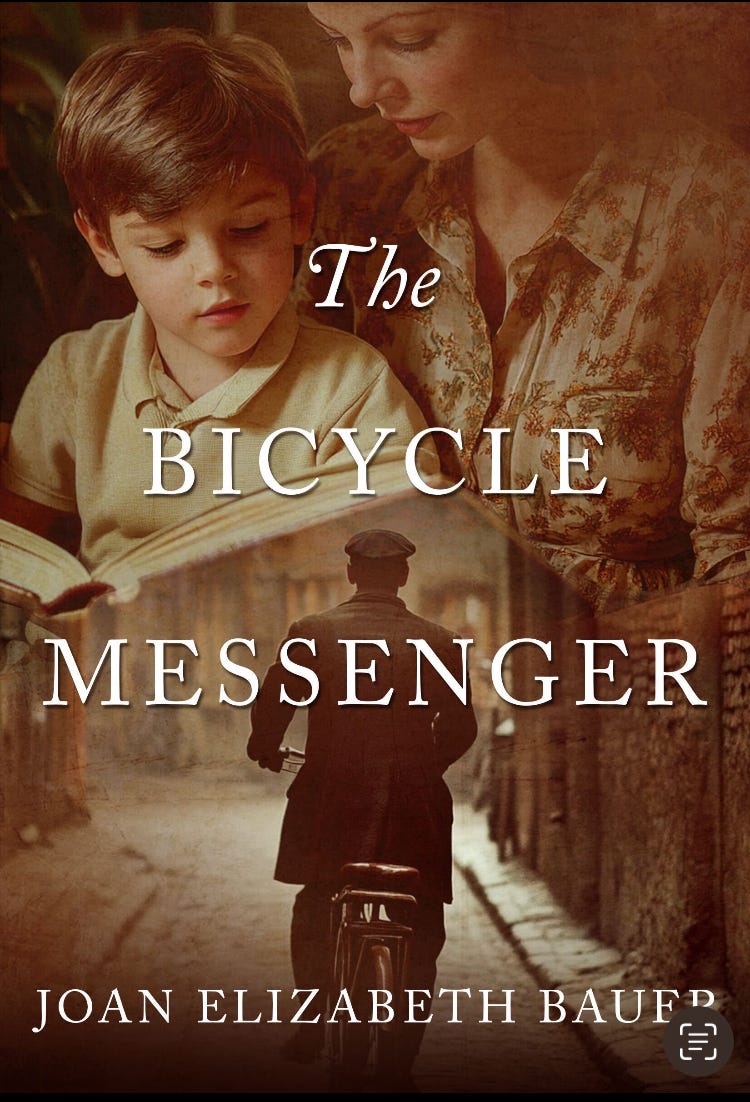
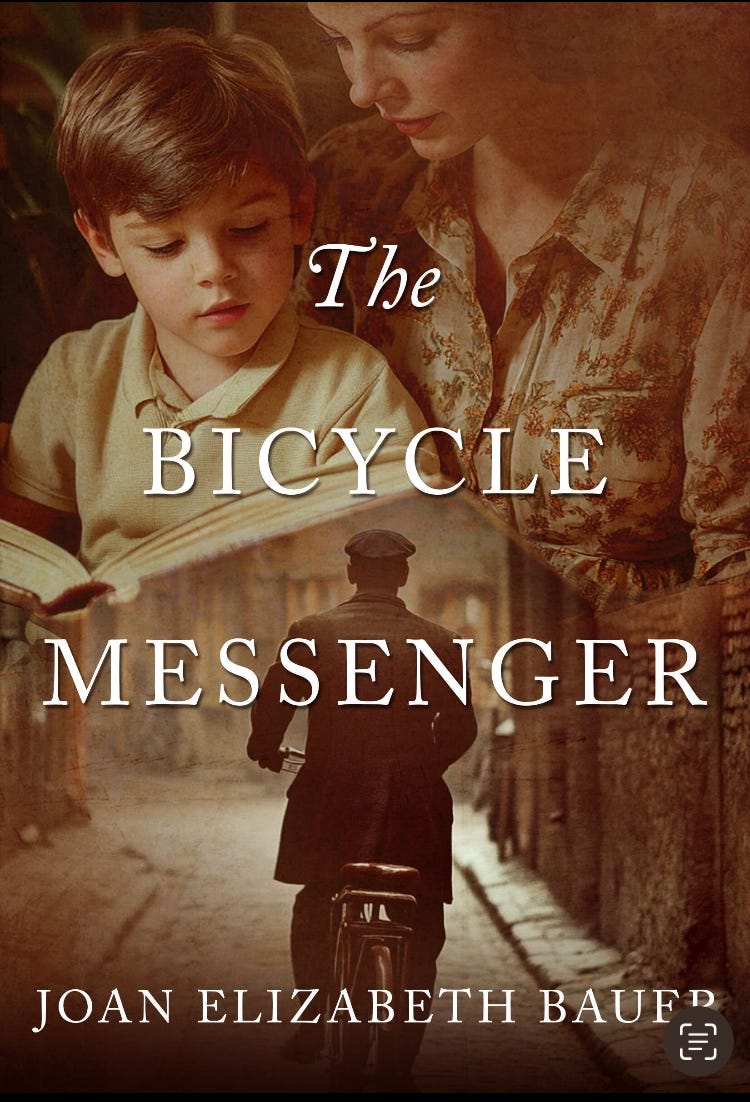
Over the past month, I’ve worked on the line edits for my novel, The Bicycle Messenger, which releases in August. The book’s action spans more than seventy years, and parts of it were written in different seasons of my life, so I’m especially thankful that God in His infinite goodness created editors. For me, preparing this manuscript for publication has been a useful exercise in obedience.

Like most writers, I sometimes struggle to “kill my darlings.” We can get too attached to our work, cherishing and repeating certain sentences to ourselves until we can no longer recognize problems. (Hopefully, the short-form immediacy of Substack will help me out here.) To read one’s own manuscript and find such a cherished sentence pared back or even deleted can put us through the five stages of grief—even though we know in our heart of hearts that the editor is right. But that’s really just pride, and the cure is obedience. God does not give us the last word on our own work or even our lives. We need one another—we need Him to complete this work in us. The sooner we realize this, the sooner we can bear fruit.

While some scenes had to be trimmed, others required cultivation. The novel opens in the 1970s, and to help ground the reader in the historical moment, I embarked on a joyful scavenger hunt through my own childhood. I watched clips of favorite TV shows like Mary Tyler Moore and Carol BurnettABC’s Afterschool Special and early episodes of Sesame Street. Kudos if you can remember an orange on Sesame Street singing an aria from Carmen! * By the way, did anyone else have that whiplash effect watching present-day Sesame Street with their own kids? The pacing has quadrupled at least!

Choosing children’s books to include was even more fun. My mother used to read us The Snowy Day by Ezra Jack Keats. Like Sesame Street, that picture of a little boy in a red snowsuit leaving blue footprints in the snow evoked urban wonders in my suburban Omaha childhood. Here in Wisconsin, we’ve had a dry winter, but last week, there were three snowstorms in as many days. As the first storm approached, I was reviewing a scene in which my characters step off a slow-moving bus late at night to walk home through the accumulating drifts, and by the time one of them sank into a hot bath, my wonder returned. For the first time since I can remember, I couldn’t wait for the snow.

There was nostalgia in this, of course. But rereading my own work with the editor’s subtle improvements produced an almost trancelike effect. The text was just different enough that it could surprise me again, and I found myself inhabiting the action and empathizing with the characters in new ways. The scenes I once tapped out at my dining room table have somehow taken on life and become a whole novel; little improvements in pacing have set off miraculous new effects, like snowflakes swirling down in the cone of light from a streetlamp. God is good. Obedience leads us to freedom.

*Good catch, Karen!

I thank my God every time I remember you … being confident of this, that he who began a good work in you will carry it on to completion until the day of Christ Jesus.

Philippians 1:3, 6

Recent Reads -January 2025

In which I take Holly Ordway’s Advice

Last November, at the Well-Read Mom annual conference here in Milwaukee, Tolkien scholar and Word on Fire author Holly Ordway spoke to us on “How to be Adventurous, Wise, and Charitable as a Reader.” Among Dr. Ordway’s suggestions was to sample various genres beyond the ones we usually read. This recommendation dovetails nicely with the mission of Chrism Press, which “seeks Spirit-filled fiction in all genres,” including romance, gothic horror, science fiction, and fantasy. I’m especially excited to promote Chrism Press, because in August, they will publish my debut novel, The Bicycle Messenger.  I’ll have more to say about that in an upcoming post. But in the meantime, here are three great Chrism Press titles you’re going to love.

Romance: Love in the Eternal City by Rebecca W. Martin

I was first attracted to Rebecca Martin’s writing when I heard her speak on a LegendFiction panel (you can find it here). She just sounded so likeable—and as it turns out, so are her characters. Elena, a young American journalist, has just accepted a public relations job in Rome after her former engagement to Chris goes up in flames. Elena is wounded, of course, but not bitter; she’s fresh and candid and eager to embrace all the potential of her new life—beginning with her friendly landlords, Paolo and Angela, who rent her a charming apartment above their tabaccheria.

Elena isn’t looking for love when she meets Benedikt, a handsome Swiss Guard, in the Campo Santo Teutonico. But Benedikt’s exuberant stepsister Rianna quickly befriends Elena, providing her with a good opportunity to get to know Benedikt too. And soon, they are working together on a major fundraising gala. Like Elena, Benedikt is discerning his future life; his wealthy father wants him to take over the family business, but Benedikt loves being a Swiss Guard and would like to advance. Beni and Elena are surrounded by a delightful cast of mentors-turned-matchmakers, starting with Rianna and going all the way up to the Holy Father himself.

Love in the Eternal City includes a frank and sensitive portrayal of Elena’s struggle to maintain good mental health. Thanks to Martin’s generous authorial voice and the goodness of her characters, we do not fall into depression alongside Elena; instead, we develop our empathy as we read. When Elena’s former fiancé interferes in her life once again, Elena finds herself snapping at Beni almost against her will: “the bitter voice has strangled the true one.  … My life is a self-fulfilling prophecy. I’m letting the man who hurt me drive away the man who cares.” Elena really struggles to be loving toward Beni when she’s depressed. It’s here that her attempts are most worthy and admirable, even when she fails. I could easily imagine Christ coming nearer to her in these scenes, sending her people who care.

Meanwhile, Beni protects the pope as he goes incognito to minister to immigrant families at a local children’s hospital. But as it turns out, the one who goes to protect the Holy Father is the one who receives a grace he didn’t even know he needed. Beni is honest with the pope about his trouble with his father. In return, the pope offers a diagnosis: “The anger isn’t his problem; the anger is your problem. You’ve never forgiven him for the piecemeal abandonment after your mother died. Maybe you’ve never even forgiven him for his own grief.” The pope hears Beni’s confession, and he is so insightful that Beni wonders if he was once an intelligence officer. There’s a lively bit spy-craft to enjoy in the book’s dénouement.

Gothic: Wake of Malice by Eleanor Bourg Nicholson

Wake of Malice reminds me of a BBC police procedural featuring a setting like Oxford or a priest turned detective—in other words, someone should option this book for a miniseries, and soon. It’s 1908, and Hugh Buckley–gentle and portly, haunted by the memory of his harsh Irish mother—lives in London and writes for the Pall Mall Gazette. But when a priest is accused of embezzlement, Hugh and his thoroughly English photographer colleague Frederick Jones are sent to the village of Doolin in Hugh’s native Ireland to cover the story. “Could the mere mention of Ireland bring back the nightmares of my childhood?” Hugh wonders. “London had seemed such a safe, impersonal place.” And before they even arrive, the crime escalates to gruesome murder.

The mysterious land of the Burren and the Cliffs of Moher reawakens Hugh’s Catholic faith, which he has long tried to suppress. Some of the locals, especially the women, have been meddling with the occult, grafting superstition onto their practice in a dangerous way. “‘There are some fierce and fiendish women hereabouts,” Hugh says to Freddie. “I’d be afraid to meet Mrs. Gorman of a night, especially if you happened to have squashed her favorite illicit tradition’”—i.e., a pagan festival that is quickly canceled by Father Brendan O’Connor, a stern Jesuit priest who takes over the parish while the local pastor, Father Michael James Walsh, is being investigated.

Hugh knows all the ancient legends, but he still makes the mistake of crossing a wide field, where he is bitten by a tiny, mysterious creature. The wound troubles him for weeks until it comes to the attention of Father Thomas Edmund Gilroy, a smiling, bespectacled Dominican priest who has come from England to support his beleaguered priest friend. Father Thomas Edmund has useful experience dealing with the occult. But at first, Father Brendan O’Connor refuses his help.

Wake of Malice features all sorts of colorful characters, including the haughty and beautiful Doireann O’Hara, granddaughter of the first murder victim; a good crop of local gossips in the pub where Hugh and Freddie are staying; and a group of Romanis who will lend a hand at the appropriate time. More murder victims pile up, some of them fearfully mutilated, their bodies surrounded by gold coins. The two journalists feed copy and photographs to their boss at home in an effort to extend their stay, because both Hugh and Freddie are becoming part of the local fabric. Hugh begins to dream of the farm life he once enjoyed, even delivering a calf for a cow in distress. He eventually admits to Father Thomas Edmund that he stopped going to mass after his mother’s death. “When she died…well, in London, no one woke me or beat me or fretted me anymore. On a Sunday morning, I found I slept well and deeply, and no one roused me. And…well, it seemed a much less frightening existence.” Life became “dull and safe.” But as Father Thomas Edmund assures him, “You aren’t the sum of your poor mother’s fears. God in His graciousness will supply your every need. Stop hesitating and let Him.”

Wake of Malice is a rollicking read that features lots of clever dialogue and even a bit of romance, along with sinister forces that need defeating.  Eleanor Bourg Nicholson delivers it all with a good dose of humor.

Fantasy: Misshelved Magic by S. R. Crickard

In Crickard’s debut novel, Adelina is a plucky librarian who often feels overlooked, and Leon is a talented student of magic who needs a topic for his senior thesis. Adelina is assigned to the history department of the library, where she is strictly enjoined to stay away from the barrier of glowing stones that demarcates the spell section. But one little magical book keeps finding its way to her shelves, and when Adelina tries to return it, she finds herself face to face with a cervara, one of a group of magical creatures who protect and defend the spell section of the library. Adelina longs to befriend the cervara; they seem so lonely in there, and she’s a curious person.

But as we soon learn, an epic battle between good and evil is raging in this little place. Crickard has a very light touch, but she draws deeply on rich images from salvation history. Adelina’s visits to the spell section brought to mind Dante’s Inferno—or, rather, Purgatory, with the cervara as the poor souls who must atone for a particular sin they have committed during their earthly lives. The First Spell that has ruined the cervara stands under lock and key in the grove at the center of the spell section of the library, rather like the tree of knowledge of good and evil in the lost garden of Eden.

But just as original sin affects all of fallen humanity, the pull of the First Spell works its way into Leon’s mind. One of the things I love about his book is the way it enacts temptation—specifically, the temptation the serpent poses in the garden: you shall by like gods. Leon is an extremely promising student, but he is plagued all along with feelings of inadequacy, and in a moment of crisis, he is tempted to hubris. Like the cervara before him, Leon believes he can wield the First Spell without succumbing to its danger. “The spell needed him. The king and the college would see his worth. He’d be invincible, and no one would ever question him again.”

But as any good reader of fantasy knows, the solution to the word’s problems is not to be found in magic. This book has profound things to say about the importance of embracing our humanity through literature instead of trying to overcome it through technology or our own strength, represented by magic. As Leon says to Adelina, “I can write spells that alter or conjure things, but your poems bring understanding.”

Recent Reads – December 2024

Shop Local

Fire Conditions by Thomas C. Malin (WWA Press, 2024)

I love to celebrate the work of small presses. This fall, the Wisconsin Writers Association has released Fire Conditions, a coming-of-age novel by Thomas C. Malin.

One of the things I admire most about this book is its strong sense of place. Set in the nineteen-fifties in the town of Friendship in Adams County, Wisconsin, Fire Conditions is the story of Mike and his younger brother Jimmy, who travel from Chicago to spend the summer with their grandmother while their parents work out some difficulties in their marriage. Along the way, Mike joins a club called the Big Fish People, builds a fort, has his first kiss, and looks out for his little brother. But there are dangerous forces at work, even in Friendship; and soon, Mike must determine what kind of man he is going to be.   

Friendship is chock-full of colorful small-town characters. Readers who grew up on The Magic School Bus series might recognize a nod to Miss Frizzle in Grandma Flowers’ colorful dresses printed with daffodils or purple iris. When the sirens wail in the middle of the night, Grandma Flowers scrambles the children from bed to try and beat the sheriff, who is also her boyfriend, to the scene of a fire. Having ceded her entire house to her dogs and her parakeet Pookah, Grandma Flowers houses the boys over the bar she runs. This is in stark contrast to the boys’ other, wealthier grandparents, who have built a fancy compound on a nearby lake.

Grandma introduces the boys to her friend Lena, who lives in a remote place and just might be a Wiccan; and while this troubled me at first, Malin gives us a sensitive treatment of religion elsewhere in the book. He presents the town’s Lutherans and Catholics without caricature, and when the boys attend their first church funeral, Mike wrestles with questions of belief in an age-appropriate way. Similarly, Mike acknowledges the prejudices of some of his elders without sharing them. Malin brings a light touch to Mike’s friendships with Goose, a member of the Ho-Chunk Nation, and Will, who has lost his mobility to polio. The story beautifully evokes boyhood in the nineteen-fifties: readers will love to imagine themselves out in the woods building forts or going to club meetings without constant parental supervision.

Of course, any book that features a fire-chasing grandmother with her own pistol is bound to end up in adventure and danger, and Fire Conditions does not disappoint. There is plenty of peril and mystery to go around. But near the end, there is also an unexpectedly moving and delicate portrayal of the aftermath of childhood trauma. Fire Conditions is a delightful sojourn “in the town called Friendship, its first name being Adams, where we Big Fish People played and worked and cared deeply about each other.”

Recent Reads – September 2024

A Look Back at Summer

Child of my Heart by Alice McDermott (2002, Farrar, Straus and Giroux)

A Month in the Country by J. L. Carr (1980, reissued by New York Review of Books in 2000)

Word on Fire’s Women of the Catholic Imagination: Twelve Inspired Novelists You Should Know is the gift that keeps on giving. When I reviewed it here in July, I was only familiar with half of the novelists featured, leaving me with an excellent list of good things to read. Since June, my husband and I have visited six used bookstores in four different states, where I’ve been cruising for titles by Muriel Spark and Alice McDermott.

Set in what might be the nineteen-seventies, McDermott’s Child of my Heart is the story of fifteen-year-old Theresa, an only child growing up in Long Island among the summer homes of the rich. Theresa is beautiful and on the cusp of adulthood— “I believe my parents had grown a little wary of me by then” –and she works tirelessly all summer, caring for children and pets while her mother and father commute to the city. In addition to her paying clients, Theresa keeps an eye on Petey Moran, one of a large and neglected brood of children living next door. Petey spends enough nights sleeping in the yard outside Theresa’s bedroom window that her parents have considered calling Child Protective Services. But in the morning, they just give him breakfast, pretending he’s only dropped over. Daisy, an eight-year-old cousin, arrives from Queens Village to stay with Theresa for a few weeks, bringing a suitcase full of brand-new and ill-fitting outfits and one very special pair of impractical shoes. Theresa takes Daisy up to the attic, where her own parents have preserved all of her childhood clothes. As they pick out a few things for Daisy to wear, Theresa lays claim to the memory of a prior existence. “’You don’t remember God?’” Theresa asks. “’Or heaven? Or the angels? Or the other children waiting to be born?’” When Daisy demurs, Theresa goes on to insist that she has always remembered the name of a brother of hers who had died before she was born. “Clearly, I said, my brother and I had met, and exchanged names, sometime between his birth and mine.”

Theresa takes Daisy on her rounds, walking dogs and picking up Flora, the toddler daughter of an elderly artist and his beautiful, vulgar wife. Early in the novel, Flora’s mother takes off for the city, leaving Flora in the hands of a jealous French maid who sets her out on the porch every morning strapped in a stroller, a bottle of Hawaiian Punch hanging out of her mouth. Theresa cares tenderly for Flora, but she also attracts the attention of Flora’s father, who spends most of his days in his art studio drinking. Other men leer at Theresa as she minds their children on the beach or by the pool.

There were things in this book that had never occurred to me, and things in which I immediately saw myself. In the mornings, Theresa eats peaches on the front porch while she finishes her book, rinsing her hands and mouth with dew. A lover of Shakespeare, she nicknames a pair of twins Cobweb and Peaseblossom, and she invites Daisy to do fanciful things that are not done at home. Eat the center out of your English muffin with jelly, she tells her, and then wear it like a ring so you can nibble it later. When a dog takes it from her in one bite, the day is sealed in her memory, along with its heat and freedom and promise. Theresa knows in her heart that something is desperately wrong with Daisy. But if she tells anyone, Daisy will have to go home.

The elderly artist, meanwhile, wonders whether he has made anything that will last. Most of his work is ugly and abstract, but three beautiful mother-and-child drawings hang above Flora’s crib—drawings that belie the neglect of the mother, the cupidity of the father.

I glanced at the three sketches in their gold frames and considered what their worth might be, when they had been claimed by the future and all that was pretty and charming about them was transformed by all that had intervened—the infant grown into a troubled woman, the mother never returned, the father and all his efforts turned to dust. But then, I supposed, with more time, all that would be forgotten as well, and they would once again be charming and pretty portraits of a mother and child—not a biography, as Macduff might have said, but a novel.

I found I preferred modern art, pictures of nothing, after all.                

This may sound a bit jaded, but perhaps it is only the speech of a prescient young woman who has seen through a weak older man. Near the end of Daisy’s visit, Theresa sees Daisy “carrying [a] gaudy kite on her back to keep the wind from bending it. A modern-art version, it seemed to me, of angel wings.” She is not the only one who comes to love Daisy on her short visit; long after the cataclysm at the end of the book, Petey Moran brings a box full of baby rabbits over to Theresa’s house.

I knew without asking that this was Petey’s gift, indistinguishable as it was from a burden. Petey, who always used to ask, challenging and pleading at the same time, ‘Do you like me? Do you like my family?’ Who had wept with his fists tight. Who would be plagued all his life by anger and affection, by gifts gone awry, by the irreconcilable difference between what he got and what he longed for—by the inevitable, insufferable loss buried like a dark jewel at the heart of every act of love.

Like Child of my Heart, J.L. Carr’s A Month in the Country captures the fleeting essence of a long-ago watershed summer. I don’t know if Carr is considered a religious writer; but in this 1980 novel, he takes up questions of faith, sectarianism, and the power of art to bring us closer to the Divine. As Michael Holroyd puts it in his introduction, “A Month in the Country is a novel of resurrection.”

Shortly after the Great War, Tom Birkin, an art restorer and veteran with a severe facial tic, sets up residence in the belfry of a church in the village of Oxgodby, in Yorkshire. He has been hired by the vicar, John Keach, to uncover a medieval mosaic of the Last Judgment. A local widow has left a bequest to the church on two conditions: 1) restore the mosaic, and 2) find the grave of an ancestor of hers who was buried outside of consecrated ground. A man named Moon, who is employed for this second purpose, is secretly mapping out the foundational remains of an ancient basilica with the intention of publishing his findings—though he will get around to locating the ancestor eventually. He lives in a tent on the property and befriends Birkin as a fellow veteran of the war.

Tom’s work attracts frequent observers, including the fourteen-year-old daughter of Mr. Ellerbeck, the stationmaster. Soon, Tom is invited to tea at the Ellerbeck home on Sunday afternoons; he finds himself recruited as an umpire for cricket and as an assistant at Sunday school. Mr. Ellerbeck doubles as a Wesleyan preacher, and once, when he is expected to visit three far-flung churches in a single day, he sends Tom Birkin himself as a substitute. This fraternization with the Wesleyans earns Tom no points with the Reverend Keach, whose beautiful wife Alice also visits Tom at his work.

Carr’s book deliberately recalls Thomas Hardy’s portrayal of life in the English countryside. Near the end of the summer, Tom joins a hay wagon ride—a “Sunday school treat” for the Wesleyans—that might have been lifted from the pages of Tess of the D’Urbervilles.

And so we clattered off, calling farewell to those disqualified by infirmity or alien beliefs from joining us, conscious (as they were) that we were part of the ancient cycle of the farming year and that our passing was token that the harvest was almost in.

Tom, whose own wife has left him, falls in love with Alice Keach, prompting the vicar to pay Tom what he is owed and dismiss him from the work. Tom counters that, if he is forced to leave now, he will tell the lawyers he was prevented from finishing, voiding the widow’s bequest. But while Tom’s love for Alice necessarily entails a denial of Keach as a man, the vicar has the last word.

The English are not a deeply religious people. … They do not need me. I come in useful at baptisms, weddings, funerals. Chiefly funerals—they employ me as a removal contractor to see them safely flitted into their last house. … But I am embarrassing you, Mr. Birkin,’ he said. ‘You too have no need for me. You have come back from a place where you have seen things beyond belief, things which you cannot talk of yet can’t forget, but things which are at the heart of religion.

Tom has numerous meaningful encounters in Oxgodby, but there’s an argument to be made that the key relationship in the book is between Tom and the unknown artist who created the mural. “Who was he? I couldn’t even name him. People don’t seem to understand those far-off folk. They simply weren’t us. Our idea of personal fame was alien to them.” But here is Tom, packing to leave and mourning the end of the summer:

Last of all, I gazed beyond the scaffolding to the great painting half hidden in the shadows. Truthfully, I felt nothing much. …Then (and I can’t explain it) the numbness went and I knew that, whatever else had befallen me during those few weeks in the country, I had lived with a very great artist, my secret sharer of the long hours I’d labored in the half-light above the arch.

Tom might not describe this as a religious experience, but what else could it be? He is attracted, even transformed, by the good, the true, and the beautiful–and by the end of a marvelous watershed summer.

Recent Reads – July 2024

In Search of Community

Haley Stewart, Ed. Women of the Catholic Imagination: Twelve Inspired Novelists You Should Know (Word on Fire, 2024)


An as-yet unpublished novel of mine once found its way into the hands of a literary agent for consideration. It’s about a young woman in a high-powered job who is unfaithful to her husband and makes quite a mess of her life. In a moment of crisis, she enters a church, where she has a transformative encounter with a Catholic priest.

I waited eagerly for the agent’s response. And while the answer was no, she kindly offered her feedback. Though she had wanted to like my book, she thought the pivotal scene with the priest was ridiculous; and by the end, she disliked the main character so much that she wished she’d get hit by a bus.

Needless to say, I went back to the drawing board. But for years after that, as I sent out my writing, I tried to keep my Catholic faith under the radar.

How wonderful, then, to discover that a vibrant culture of Catholic writers and publishers was already emerging right under my nose. My first real inkling came from a Facebook post promoting Katy Carl’s novel, As Earth Without Water (Carl’s essay on Rumer Godden is featured in Women of the Catholic Imagination). I was astonished and thrilled to read such a nuanced and beautiful story of an artist discerning a religious vocation. And as it turns out, there are many excellent works of fiction in this vein, both contemporary and classic. Some of them I knew, and some, I didn’t. For instance, did you know that Nobel-Prize winner Toni Morrison was a Catholic, and that her books can be read fruitfully in this light? How about Donna Tartt, who won the Pulitzer Prize for The Goldfinch?

Women of the Catholic Imagination not only delineates the Catholicity of some of the writers we know; it also introduces many once well-known writers whose work still deserves to be read. According to Bonnie Lander Johnson, British novelist Alice Thomas Ellis’s “large and eccentric Gloucester Terrace household was well-known for its conflation of home life, writing, painting and publishing; in this convergence of activity, Ellis’s home has been compared to the Bloomsbury Group.” I’ve just finished the first book in Ellis’s Summerhouse Trilogy, and it’s great. Julia Meszaros has this to say about Caryll Houselander: “the artist [is] perhaps the last person left to witness to the beauty of doing something for its own sake, no matter the cost.” And I’d never heard of German writer Gertrud von le Fort, but Helena M. Tomko’s description of her accords with my own experience of writing fiction:

’Creative power can only be received,’ writes le Fort. She sees this as a feminine capacity and corrective to the masculine impulse toward ‘self-redemption’ and self-creation. Her understanding of Marian co-redemption is exemplary for men and women alike, who ‘must conceive the creative spirit in the sign of Mary, in humility and surrender, or he [and she] will not receive it at all.’

As you may have already gathered, Women of the Catholic Imagination is full of great writing. Dorian Speed introduces Scottish writer Muriel Spark like this:

Half a century before Jim Carrey walked off the set of The Truman Show or Will Farrell negotiated with the novelist pulling the strings of his life story in Stranger than Fiction, Caroline Rose (a Spark character) heard her own thoughts being typed out by an unseen author.

How cool is that? I recently attended a Catholic Literary Arts panel called “Writing While Catholic,” and Dorian Speed, who was one of the panelists, characterized good fiction as a place where wounded characters receive God’s grace through their interaction with others. This exactly describes the kind of stories I want to write and read.

In addition to the writers mentioned above, Women of the Catholic Imagination includes essays on Josephine Ward, Sigrid Undset, Flannery O’Connor, Caroline Gordon, and Alice McDermott. By my count, seven of the twelve writers featured are Catholic coverts and one is an English recusant, so there’s a wonderful diversity in their stories of faith.  And beyond that, it’s refreshing to see how many of my favorite contemporary Catholic poets and fiction-writers are also very fine essayists and critics. Some of them, including Eleanor Bourg Nicholson, Katy Carl, and Joshua Hren, contributed essays to this book. Women of the Catholic Imagination is a great place to meet these writers, too.

Recent Reads – May 2024

Revisiting Jude the Obscure by Thomas Hardy

I have a distinct image of myself newly graduated from college, lying in the top bunk in a friend’s house in Sweden and finishing Jude the Obscure in the long, otherworldly June daylight. Thirty-six years have passed since then; my husband and I have raised three children to adulthood. And this month, I revisited Jude the Obscure to divine the shadow it cast on my reading of Brideshead Revisited (more on that here). But like any great novel revisited after so many years, the story opened for me in a whole new way. Now, I read Jude the Obscure as a book about mental illness—specifically depression, though the book also deals with scrupulosity.

There are a few striking similarities between Brideshead and Jude: both stories involve moral scruples surrounding divorce, and both take place in part in great university towns (Oxford in Brideshead, the fictional Christminster in Jude). But while Waugh’s Charles Ryder can afford to attend university, Jude, who is of the peasant class, tutors himself in the hope of gaining admittance one day. When a coarse young woman named Arabella entraps Jude into marriage, he takes a surprisingly progressive view of sexual mores:

There seemed to him…something wrong in a social ritual which made necessary a cancellation of well-formed schemes involving years of thought and labour… because of a momentary surprise by a new and transitory instinct which had nothing in it of the nature of vice, and could be only at the most called weakness.

This is the second time Jude is inclined to discard social norms—the first is when he resolves to be educated beyond his own class–and Jude’s many reversals exacerbate his depressive tendencies, particularly toward alcohol. The fickle Arabella soon leaves, and Jude, who is trained as a stonemason, moves to Christminster, where his more educated cousin Sue Bridehead also lives. Jude’s great-aunt warns him strictly not to contact Sue; there is some sort of curse on his family, she says, and the Fawleys oughtn’t to marry. Jude cannot offer himself to his cousin in any case, because he is not free.

When Jude arrives in Christminster after dark, he feels completely detached: “[k]nowing not a human being here, Jude began to be impressed with the isolation of his own personality, as with a self-spectre, the sensation being that of one who walked but could not make himself seen or heard.” Soon, Jude is aware of unseen presences: “There were poets abroad;” ‘Speculative philosophers drew along;” “The scientists and philologists followed.” But, in the morning, “the colleges had treacherously changed their sympathetic countenances.”

It isn’t long before Jude encounters his cousin and becomes enamored of her, though it takes him a while to unveil his identity. When Sue finally writes to him, he offers to meet her “at the cross in the pavement which marked the spot of the Martyrdom.” It is Sue who recognizes just how inauspicious this meeting place is. They start out as friends; Jude introduces his cousin to his old schoolmaster Mr. Phillotson, whose example has drawn Jude to Christminster in the first place. Phillotson has not made a success of himself, and when Sue comes to teach at his school, he falls in love with her. Sue has always been flighty and delicate; she has a fine mind, but she lacks the courage of her convictions. When she learns that Jude is already married, she impulsively accepts Phillotson’s offer—though she develops such an aversion to him once they are married that he is at last moved to release her. Sue and Jude drift from place to place in what appears on the surface to be a free-spirited and illicit union, though they live chastely together for years.

Jude the Obscure is full of remarkably modern speeches. Sue says that she “’may hold the opinion that, in a proper state of society, the father of a woman’s child will be as much a private matter of hers as the cut of her underlinen, on whom nobody will have any right to question her.’” Such anti-family ideas are socially ruinous; and yet Jude tries to placate her. “’That excessive regard of parents for their own children, and their dislike of other people’s, is, like class-feeling, patriotism, save-your-own-soul-ism, and other virtues, a mean exclusiveness at bottom.’” (Later, as Jude is losing his faith, he will accuse Sue of wanting to save her own soul at the expense of his.)

And while Phillotson suffers for his renunciation of Sue, Jude’s Arabella inconveniently reappears. She wants Jude to divorce her so she can properly marry the man she has been living with in Australia. And she announces that Jude has a son whom he must immediately take off her hands.

“Little Father Time,” as the boy is known, is a morose child who seems like an old man. His silent advent on the train is absolutely terrifying; in his melancholy nature, he takes after Jude: 

[h]e was Age masquerading as Juvenility, and doing it so badly that his real self showed through crevices. A ground-swell from ancient years of night seemed now and then to lift the child in this his morning-life, when his face took a back view over some great Atlantic of Time, and appeared not to care about what it saw.

The child’s arrival brings out Sue’s latent scrupulosity concerning her flight from her unhappy marriage. Her “supersentiveness [is] disturbed” when the boy comes; Jude “[finds] her in the dark, bending over an armchair.” And yet Sue promises to be a mother to him, though his resemblance to Arabella incites a horror in her. The child asks,

“is it you who’s my real mother, at last?” … Then a yearning look came over the child and he began to cry. She thereupon could not refrain from instantly doing likewise, being a harp which the least wind of emotion from another’s heart could make to vibrate as readily as a radical stir in her own.

Meanwhile, Jude writes to the heads of the various colleges in Christminster to ask if there are any funds set aside for the education of one such as him. The only one who deigns to reply advises Jude to remain content in his own class. But it becomes harder and harder for Jude to find work as people gossip about his unconventional family, which has now grown to include two younger siblings and a child on the way. Little Father Time absorbs these concerns, as Sue makes no attempt to hide anything from him.

“I couldn’t bear deceiving him as to the facts of life. And yet I wasn’t truthful, for with a false delicacy I told him too obscurely. – Why was I half-wiser than my fellow-women? … It was my want of self-control, so that I could neither conceal things nor reveal them!”

Jude and Sue are well-attuned to one another’s moods and can adjust for them, but the child has no such coping skills. The family makes its way back to Christminster in time for Remembrance Day so that Jude, who is quite ill by now, can indulge in self-reproach at his failure to enter the college. But when the family is unable to secure adequate lodgings together, Little Father Time brings about an unthinkable tragedy. As Jude will say later,

“[t] he doctor says there are such boys springing up amongst us—boys of a sort unknown in the last generation—the outcome of new views of life. They seem to see all its terrors before they are old enough to have staying power to resist them. He says it is the beginning of the coming universal wish not to live.”

How prescient this seems in light of the dangerous influences young children are exposed to today!

Unlike Charles Ryder, who turns toward Christianity at the end of Brideshead Revisited, Jude loses his faith when Sue drifts away from him.

“You make me hate Christianity, or mysticism, or Sacerdotalism, or whatever it may be called, if it’s that which has caused this deterioration in you. That a woman-poet, a woman-seer, a woman whose soul shone like a diamond—whom all the wise of the world would have been proud of, if they could have known you—should degrade herself like this! I am glad I had nothing to do with Divinity—damn glad—if it’s going to ruin you in this way!”

Of course, it is not Christianity per se that has caused this “deterioration” in Sue; she suffers terribly from scrupulosity over past sins. Some might say that the times simply haven’t caught up to her yet. But today’s moral laxity doesn’t support human flourishing, either.

The tragic ending of Jude is so much darker than the ending of Brideshead, and yet it does not disturb my expectations at all. I had no wish to see things turn out happily in the end, perhaps because Hardy’s sensibility feels more like the naturalism of Zola: the self-interested Arabella, having exploited Jude’s grief, lures the lascivious Dr. Vilbert with his own “love-philtre” before Jude is cold on his deathbed, while the terrible grief to which Sue is subjected deranges her thoughts. Sue and Jude have been gradually changing places, as he loses his faith while she finds a scrupulous one. There is more straightforward tragedy here, while perhaps Brideshead aims to have it both ways.

And yet you might say that Julia’s choice at the end of Brideshead Revisited–a choice that honors the Catholic understanding of marriage–revisits (and thereby corrects) Sue Bridehead’s tragic, disordered choices in Jude the Obscure. Waugh looks clear-eyed at the world with a true faith, while Hardy quotes Swinburne’s Hymn to Proserpine: “Thou hast conquered, O pale Gallilean; the world has gone grey from thy breath.”

And that’s a pagan poem I can hardly bear to read.

Recent Reads – April 2024

On (mis)reading Brideshead Revisited

Note: This post contains spoilers.

I’ve belonged to various book clubs over the years, but I’ve generally fallen away after being asked to read a few things I didn’t enjoy. Well Read Moms is refreshingly different. There’s a yearly theme and a guide, and I love the idea that spiritual book clubs all over the country are reading in tandem together. Our own group developed organically out of a few years of parish-based Lenten group study, so last summer, I was really excited to discuss Works of Mercy by Sally Thomas with some of my dearest spiritual friends. And we all loved Marly Youmans’s Charis in the World of Wonders. But I must confess that, despite the excellent commentaries that were provided for us, we struggled a bit with T.S. Eliot’s Four Quartets. (This did, however, create an opportunity for one of us to study up and give an excellent tutorial on the poems–and she wasn’t even an English major in college!)

And now, we come to the great Evelyn Waugh. Brideshead Revisited has long been a favorite of mine, but I’m having some trouble with the ending. My idiosyncratic reading of Brideshead is probably formed by at least two other great books: Swann’s Way by Marcel Proust, and Jude the Obscure by Thomas Hardy. Hardy’s characters grapple with church teaching on marriage and sexuality just as Waugh’s do. And in an amazing coincidence (but is it coincidence, really?) Hardy’s counterpart to Waugh’s Julia Flyte is named Sue Bridehead!

But more on that later. The influence of Swann’s Way has to do, of course, with the taste of the madeleine dipped in lime-blossom tea (suffice it to say that, in Proust, any episode of involuntary memory is a good thing). As Aunt Leonie’s house rises up like a stage set around the narrator of Swann’s Way–bringing with it the rooftops and church bells and cobblestone streets of Combray, where the narrator spent much of his childhood–so too rises Brideshead Castle for me as Charles and Sebastian round the bend in Hardcastle’s borrowed car. For me, the house carries all the attractions of nostalgia, and at first, the Brideshead of Charles’s past appears to stand in for the good, the true, and the beautiful–for those youthful interwar years when Charles, wearied now by his pointlessly bureaucratic military life, was discovering friendship at Oxford. This, of course, is a misreading of Brideshead, though perhaps one that Waugh might permit for the earliest pages. It is only after the house is disrupted by war, becoming a place for soldiers to billet—only after Lord Marchmain has died, and the chapel is restored—that Life comes back to the house.

Near the end, the coming war presses hard on the story’s main characters. It is the war that brings Lord Marchmain home from Italy to die, just in time to ruin everything not only for Charles and Julia, but for Bridey and Beryl. Lord Marchmain demands that the “queen’s bed” be brought down for him piece by piece and reassembled in the Chinese parlor; he disparages Beryl and threatens to write Bridey out of the will; and at first, he dismisses the priest who comes to offer the last sacraments. The war presses on Julia, too, hurrying her along the path of divorce and remarriage that will ultimately separate her from Charles. And, finally, it is the war, and Charles’s rather pointless role in it, that makes him world-weary and sad. Frankly, until the last two sentences, Charles doesn’t sound at all like a man who has discovered the spiritual life.

I know I ought to rejoice when Lord Marchmain finally makes the sign of the cross on his deathbed. And I do rejoice–though probably not as much as I should–when Julia finally stops fending off the Hound of Heaven who has so graciously separated her from her sin. And I’m happy for Charles at the end of the book as he kneels before the tabernacle in the chapel, where the Eucharist has been restored. (I feel sure that the shell-shocked old priest who reopens the chapel at Brideshead is a stand-in for Sebastian, who is living out his days as an alcoholic eccentric in a Tunisian monastery.)

In other words, I know that the book ends in grace. But that’s not how I feel. Instead, I feel like something terrible and tragic has happened. When Julia renounces Charles, who says he hopes that her heart will break, I’m completely on his side. I find myself asking, why can’t she get an annulment? After all, her marriage to Rex took place outside the Catholic church, and Rex had been married before. As for Charles–well, if either party entered into Charles’s first marriage without proper intent, it was probably him. Oh, never mind. I just want things to work out! I want consolation in the form of a happier ending; perhaps I ought to try harder to accept desolation instead. But it just seems to me that the “severe mercy” of Sheldon Vanauken’s novel of grief is pretty severe in Brideshead. It’s a severe mercy indeed for Charles to know that Julia lives, and that she has turned away from him for the good of them both.

And if Charles is going to believe and convert, shouldn’t there be more joy in it for him? Instead, the war comes, and the house is ruined, and Julia and Cordelia both enter into a hard, bleak life. And yes, Charles has had the advantage of years to get over the fresh wound of losing Julia. The book’s very last sentence– “You’re looking cheerful today!” –briefly gestures at joy. But I took very seriously the bleak opening in the prologue about the age of Hooper and Charles’s lack of real purpose; I took seriously Charles’s lament that at thirty-nine, he began to be old. A ruined Brideshead with a restored chapel is a beautiful thing, I know. But I still cherish that nostalgic vision that opens the book–especially after the war requisitions the house and makes it quite certain that Charles and Julia will run out of time.

Cathartic, isn’t it? Maybe my reading (I do believe; help my unbelief!) isn’t so far off after all. I’ll have more to say about Thomas Hardy next month.

Recent Reads – March 2024

Poems and Vignettes

Memory’s Abacus by Anna Lewis (Wiseblood Books, 2024)

The title poem of Anna Lewis’s debut collection waxes and wanes on the page. A grandmother with “swollen knuckles” recites the names of her cousins, some of whom are long dead; and as she speaks, she

taps on the

Christmas tablecloth as if

there lay memory’s abacus.

In its simplicity, this poem is hardly more than a string of names, like beads on a necklace; and yet Lewis beautifully locates the evanescent—whether it be a memory, an experience, a resemblance, or an insight–within the concrete image. In “Childhood Home,” the speaker remembers her Babinka tugging a branch of the dogwood tree

down close to give a look:

the rusty stains at petal’s edge

denoted holy wounds;

the bristling core, a crown of thorns;

the Passion in a bloom.

Like St. Patrick explaining the Holy Trinity with the leaves of a shamrock, Babinka’s perhaps inadvertent tutelage imprints on the child’s mind, where it is interwoven with nostalgia for a house “full of stairs and doors.”

Section II of the collection beautifully explores the triolet, an eight-line poem that achieves its effect using formal repetition. Lines one, four and seven are identical or nearly identical, as are lines two and eight, and the rhyme scheme is tightly limited. But changing context reveals new facets of each repeating line, as if one were turning a diamond to catch the light. Collectively titled “Reveries of a Mother on Foot,” the forty triolets of Memory’s Abacus are in a sense a single poem. A mother pushes her sleeping infant in a stroller, freeing her to think her own thoughts. “Beneath our humid, morning sky, I splice / motherhood and solitude without a trace.” And yet, her reflections are as evanescent as the temporary quiet she has purchased with her walk. “Our journeyings and dreams aren’t ours to keep. /… A puddle glimmers: mirror-fair, sky-deep.”

Her child, of course, is too young to remember these early experiences– “it takes some time to start to build a past” –but as they walk, the mother teaches him the words for things, and he repeats them as best he can. “We sing our song of mirrored syllables. / Each slip of sound invites its twin to play.” Here, the word “twin” refers, not only to the baby’s childish mispronunciation, but to the child’s own “twin“—i.e. the mother herself, when she was a girl. In “[a] hint of me, the girl I used to be,” we see a child who “kept her longings neatly tucked away,” who “snipped her steps, avoiding every crack” even as she looked over her shoulder at the unknown past. Now, as an adult, she is “still finding walking is a way of dreaming, / of wandering into memory’s hidden tracks.”

In one of heredity’s most beautiful gifts, the speaker reflects that her infant resembles her deceased grandfather: “There’s an ache and some solace in seeing / a face within a face, his image peering through.” With this insight, “A daily route grows newer by the day.” The poem proceeds through the mother’s thoughts: about discord and the sufferings of others, about memory and the pilgrimage that remains unfulfilled in this life. Near the end of her walk, as the daylight fades, she sees that “[h]eads bowed, the Lenten roses seem to pray.” When I was a new mother, I often pushed the stroller just like this so I could be alone with my thoughts, and these lines ring gorgeously true. Like the trajectory of an involuntary memory–a moment that we must pause and experience while it lasts–the poems of Anna Lewis’s debut collection gather and elevate, leaving sweetness behind as they ebb.

The O in the Air: Poems by Maryann Corbett (Franciscan University Press, 2023)

While Anna Lewis locates an image of the Passion in a flower, Maryann Corbett takes a further step back, asking, as she longs for roses to bloom again after a long winter, “[w]ho was the first to imagine prayers as blossoms?” Both poets reflect on their childhoods; but where Lewis assumes the persona of a young mother imagining a future for her child, Corbett looks back in maturity, divining the secrets of her elders and tracing their marks on her psyche. And around certain corners–even under our feet–we glimpse the hidden action of God.

The opening poem in Corbett’s collection describes a painting by Brueghel in which a foregrounded landscape contains a far-off scene from scripture embedded like a seed, inviting our gaze beyond visible reality toward the invisible sacred that illuminates it all:

It’s there, if you look past mere vision’s weakness.

The question, always haunted by its answer:

What if the world you learned in flame and darkness

Is apprehended only through these fancies?

What if the whole of it is heavenly?

The collection begins with speakers who struggle with puzzling questions from childhood. A truth might remain hidden because we were too young at the time to interpret what we have seen; but when we are older, the principal actors in the original drama often cannot explain. Thus, we are left with the overwriting of memory, sifting its choices and lapses. In Sorrowful Mysteries, the speaker is suddenly reminded of the frantic nighttime arrival of one of her parents’ friends: “[t]hrough a glass of years, darkly,” the scene from her childhood “gathers shape, then fades.” Clearly, someone has been driving drunk; perhaps the police have been called; there is a hint of impropriety— “She’s got a hell of a nerve, / writing us here” –but as to the substance of it, we do not know. “This is childhood’s essence,” Corbett says, “always to grope in the dark.” And

What the grip finds, it hoards

to worry in its fingers.

To tell, like rosary beads.

Here, the act of telling is synonymous with praying; you might say that the stories we make from our experiences are sanctified when we offer them to God.

In “Knowledge,” a daughter discovers her elderly mother’s previous marriage, which ended in divorce after her first husband virtually abandoned her during the war. The mother’s subsequent remarriage kept her from receiving communion until an annulment late in her life restored her to the Eucharist. In the midst of the daughter’s anger at the man who abandoned her mother—an act that distorted her childhood–the poet resolves to keep this family secret. After all, due to her mother’s cognitive decline, “[m]ine is the only memory / she has.”

Other truths of the past seem to lose their freshness, their appositeness, in modern-day contexts. In “Lavoro all’uncinetto,” an Italian grandmother’s precious lacework deteriorates over time into a mere means of financial support:

And holiness, subject to dust and ashes

(house dust, ash from my father’s cigarettes,

Impatient handling, children’s grubby hands)

Broke down.

What happens now? Who values patterned beauty?

Form on repeat, like rosaries or song?

Young children frequently appear in this collection, including one who joyfully sings out the word “cake!” during mass as the host is elevated: “Not quite the party I wanted,” the speaker says, “but it serves.” The “holy, wounded memory” that haunts the Eucharistic feast might be a personal one–or it might be the Passion, symbolized by the crucifix hanging over the altar.

In “Ardors,” Corbett turns toward the dying of the year, when nature surrenders itself to God in perfect trust that spring will come. The trees, however, seem to share our fallen state:

As if the sin of Adam took its toll

on trees, the maples stricken with the fall

burn in their sins. Red passion and proud gold,

their vanities float down like scraps of flame.

The days of burning leaf piles are over; “[n]ow the tumulus of compost / seethes” as the earth inevitably winds down, however slowly:

All our burning’s doomed,

even these fires where maple trees are found

still ardent after years, still unconsumed.

Other poems take a more whimsical tone. “To the Unknown God” declares an internet router to be the “newest of idols.” Meanwhile, the water-heater, “pure as a temple column, / went marble-cold to the landfill.” And yet we are

hauling new deities in

to a pantheon of deadbeats,

while we glance over our shoulders

at the town gates. Oh, they rattle!

The final poem of this middle section is “Hoarder”: “To get past stuff, it seems you have to die.” This line points us neatly toward the last part of the collection, which is full of endings. An older couple buys a burial plot; long-time neighborhood residents watch transitory students cast their belongings to the curb at the end of the semester; a popular drive-in is closed. In “Monuments”, Polish and German war dead achieve detente in a cemetery:

The snows of every winter white them out,

and with the summers, over all this absence

the great blade of the mower passes, sighing.

I saw myself in the poem “Praying Sleepless;” I am often beset by distraction (“What does adoring / feel like? Like fingers itching for a cell phone?”), and I sometimes pray best when I wake in the middle of the night. The speaker of the poem learns to rely on memorized vocal prayer, where she can

          fall, into the surf of repetition,

hail Mary, holy Mary; hidden behind

the wave machine of mantra, aiming at You

but slantwise, down the curl.

And like the speaker of “A Dream of Rooms,” I frequently dream of shapeshifting interiors that seem to grow bigger and more cluttered as I attempt to move through them. But here, the opposite dynamic is at play. The place of “stairs and doors” Anna Lewis evokes in “Childhood Home” is swept clean and bare in Corbett’s poem of loss:

The house, he knows, is theirs.

Doors open into rooms he’s never seen.

These rooms are empty and polished; they have somehow been “stripped of pointless things. … Their early indiscretions in deep pinks / and greens have been absolved.” And when the bereaved speaker awakes, he finds himself alone.

There are many more gorgeous poems I could have highlighted here. This is a collection to savor again and again.

Becoming Human: A Collection of Vignettes on Grief, Connection, and Longing by Natalie Kathryn Sanchez (2023)

There is something heartbreakingly close to the surface about the writing of a young person–someone who has not yet ceased to notice things, to generously give herself over to the visceral experience of nature or to a surge of emotion. Natalie Sanchez, the oldest of four children, suffered the sudden loss of her father when she was a senior in high school. This is her second book about grief.

Between the two books, as she says in her introduction, “I needed to leave space for the paradox: Grief is greater than me, intertwined with emotions beyond our language, and I am so much more than my grief. … This book is … an invitation to come back to ourselves time and time again.”

Sanchez does this by entering fully into the experience of grief as it arises in everyday life. Some of the reflections are essentially poems:

I have a recurring dream that you faked your death,

another where you are an absent father,

as if you chose to leave me.

And while she always longs for him– “[o]ur car conversations gave me an early recognition of experiencing time instead of counting it” –she tries to absorb herself in music or in a challenging bike ride that unlocks her euphoria. These lyrical prose essays are full of crisp images that have the savor of poetry. In “My Little Brother,” Sanchez longs to shield a child who must endure yet another funeral while “[t]he earth tosses and turns on its axis like an irritable insomniac, indecisive clouds parting and rejoining while we wait.” In “Sprinklers,” Sanchez remembers how, as a child, “fireflies lit curiosity between your palms.” “Dinner Table Fears” serves as a dispatch of sorts from the cusp of young womanhood to one’s future self, as a group of old high school friends gather to drink honey shrub cocktails, each of them “scared to disappoint another version of ourselves.”

But many of the pieces show us a young woman successfully navigating the world through her pain and helping others to do it. In “Choices,” Sanchez brilliantly nails the opening line: “[b]etween our first round of waters and the check, my brother chooses a college.” And in “My View from the Bleachers,” she suffers with a younger brother who is stuck on the sidelines even as she witnesses his growing resilience: “[f]rom the bleachers, I see a man emerging through his sprouting shoulders.” As she grasps after her fading memories of her father’s outline, she recognizes that she has taken on “[t]he shape of your absence, a soft semblance of what you left behind.”

Paul Sanchez passed away on March 9, 2018. How proud he must be of his Natalie now.

Recent Reads – February 2024

Showcasing Catholic writers with ties to Milwaukee, Part Three:

Letting in Air and Light by Teresa Tumminello Brader

Belle Point Press, 2023

Teresa Tumminello Brader lives and writes in New Orleans. But she attended Marquette University, so I hereby claim her for the city of Milwaukee as well. Letting in Air and Light, Brader’s lovely hybrid of fiction and memoir, turns on her discovery of a family secret. After an exhausting period of caring for her dying mother, Brader spreads out the February 26, 2010 edition of the newspaper to learn that her uncle, William J. Toye, has been arrested in an FBI raid for art forgery. And while the crime is sensational, Letting in Air and Light is mainly a story of family, mental illness, and home.

The voice of the book is divided, reflecting its dual purpose. As a memoirist, Brader must come to terms with her uncle’s exploitation of the name and reputation of Clementine Hunter, a self-taught Black Louisiana artist, and with her mother’s decision to keep the truth from her all this time. But as a novelist, Brader peers into the mirror of life, teasing out the good, the true, and the beautiful; and in this vein, she skillfully ventriloquizes the thoughts and feelings of her family members, who become characters or even narrators themselves.

There is something meta-fictional about the memoir-style entries, which roughly alternate with the fictionalized accounts. Toye is extraordinarily talented, and early in his career, he supports himself with set design and architectural work–even posing, Zelig-like, as a symphony conductor because a famous musician shares the family name. The book’s title refers to an early childhood memory in which Teresa sits on her uncle’s lap, punching out the windows and doors in an architectural model he has made out of balsa wood. “I could use this punching out of windows and doors as a symbol of destruction,” Brader tells us. “Or I could offer it as a metaphor for letting in air and light to an enclosed structure, one that my mother tried to keep that way.” Specifically, we learn that Toye was first accused in the nineteen-seventies, but Teresa was never told. In the fictionalized account, she searches the house for the funnies one day after school, and no one will explain why that day’s newspaper (which contained an account of her uncle’s crimes) has already been discarded. This dual structure avoids the trap of authorial intrusion while enacting the process of reflection and judgment that adults eventually bring to bear on their childhoods.

Brader beautifully evokes her grandparents’ double-shotgun house, where much of the story takes place: “the red-and-white checkerboard tablecloth. … looked as though someone were constantly passing a damp washcloth over it.” In the dining room, young Teresa plays with her aunt Helen’s typewriter and studies her record collection; in the front room, she helps herself to the books. The fictional sections are organized according to the changing rhythms of home: “A Starter House,” “A Shotgun House,” “An Opera House,” “Asylums,” et cetera. Meanwhile, Brader’s treatment of William Toye moves between empathy, wonder, unease, and shame. Here, young William is experiencing an early psychotic break:

The school’s pigeon-gray walls moved inward, closer and closer. Billy tried to quicken the pace, but his legs wouldn’t cooperate. He tried to shrink into himself, but he was already as thin as a blade. He scuttled sideways like a crab…. Bumped on both sides, he collapsed, his knees folding like the Hotch Potch character that taught colonial children their ABCs. Scrunched into a ball, resembling no letter from any alphabet, he went blank.

The story proceeds in a series of beautifully rendered anecdotes, milestones, and tragedies of family life; but as Brader matures, she is caught between her duty to her mother and her desire to learn the truth. After her mother’s death, Brader travels to Lafayette to hear a talk given by Randy Deaton, the FBI agent who investigated her uncle’s case. She has decided in advance not to reveal her family connection to anyone, reflecting that that if her mother were still alive, she might never have attended at all.

Once I’d returned from the talk, she would have wanted to know all about it.  Ironically, she didn’t like things being kept from her. I would have told her what I learned. I would have answered her questions. I would’ve been hoping to help break the chain of secrecy, the one that breeds more secrecy and grows unwarranted shame.

The FBI agent passes around one of her uncle’s forgeries, and

[t]ime feels wobbly again, the surreality of my situation intensifying. I came to the talk with no preconceptions as to an outcome, but I almost feel as if a dream-pencil appeared in my hand and I drew these happenings. My mind churns with all the things I could say.  …. I think of myself as a toddler sitting on Uncle Bill’s lap, as his forgery is now sitting on mine.

In the end, Brader chooses to treat her family with mercy. Letting in Air and Light recalls Sarah M. Broom’s National Book Award-winning memoir of New Orleans, The Yellow House, in which a matriarch’s efforts to patch up the flaws in her house enact the struggle to keep a disparate family whole.

Recent Reads – January 2024

Literary Historical Fiction

The Dead of Winter, by Paul David Bauer

Vol. 4 in The Coldest Winter in a Century

One of the great privileges of my life is to serve as the first reader for my husband Paul, who has just published The Dead of Winter, the fourth of seven planned volumes in his epic series The Coldest Winter in a Century. Coldest Winter follows four characters during the second World War: Captain (and later Major) Ed Rybowski, a Jewish company commander in the 1st Battalion of the 22nd Infantry Regiment; Ed’s college friend Billy Randolph, son of Virginia’s senior senator and an intelligence officer at SHAEF; Billy’s younger sister Mary, a hard-working Washington insider and Ed’s soon-to-be ex-wife; and Ed’s former girlfriend Cathy Quinn, a nurse from a big Irish Catholic family who is caring for wounded soldiers on the home front. Coldest Winter takes us into the heart of the European conflict via the Hürtgen Forest, the Battle of the Bulge, and the prisoner of war camps (in a remarkable passage in the third book, Be Not Afraid, Billy Randolph visits Treblinka under the guidance of Ukrainian-Jewish novelist and journalist Vassily Grossman). Meanwhile, Mary Randolph is sent on a mission to Alaska to reconnoiter a site for a dam—a massive New Deal project destined never to be completed. And Cathy, who has married the wrong man on impulse, keeps an eye on her nursing cohort and her colorful brothers while making frequent confessions.

Coldest Winter is a brilliantly-researched passion project that sits somewhere between Patrick O’Brian’s Aubrey-Maturin series and Hilary Mantel’s Henry VIII trilogy. The story has been the undercurrent of our marriage: when I first met Paul, he was writing what would later become Mad River Run, a prequel to Coldest Winter set in Princeton, New York, and Vermont in December of 1939. Here, we meet the characters in their idealistic youth. Billy, who harbors Communist sympathies despite his patrician origins, dreams of fighting in the Spanish Civil War with the Lincoln Brigade, while Ed, who is Jewish and from Brooklyn, broods over the ongoing German invasion of Poland. As a young person, Billy has many flaws—he’s impulsive, grandiose, and a womanizer to boot—but he is utterly loyal to Ed, the smartest person he knows. In Mad River Run, Billy leads Ed into all sorts of misadventures, beginning with some pool shark action at Princeton’s Ivy Club and ending with an ill-advised episode of night skiing at Mad River in Vermont. Meanwhile, Ed tries to come to terms with the violent death of his father, Wladislaw Rybowski, whose true business Ed does not yet understand.

Through it all, Ed is our polestar, the figure around whom all the disparate characters revolve. His voice is laconic, introspective, sometimes fierce. Here’s a sample from the early pages of Mad River Run, in which Billy and Ed, both lacrosse players, have just finished a punishing afternoon run and are lying under what Billy calls the “Tree of Doom:”

Randolph said to concentrate on the sky to forget the pain. Billy was always talking that way. Announcing theories. Commanding commitments. Calling in the chits of manhood. It was his manner of friendship. Looking up through the black branches of the old tree, he said the late afternoon sky was like some girls’ eyes when the music stopped, an expectant blue, “full of potential.”

There was always potential in blue-eyed girls for boys like Billy Randolph, Ed thought.

Life will darken in time for all of these characters; both the male and female protagonists must confront the physical and moral perils of the times in which they live. Here is Mary in Alaska, after having suggested that a Russian flyer might have revealed something interesting to her while in his cups:

It was the disease of government that people often pretended to possess more information than they really did; it was a badge of status in Washington to be “in the know.” She had always despised people like that, peripheral nobodies who claimed to have inside dope. They were dangerous too: loose lips, sink ships and all that. But she had fallen into the same trap, pretending to know something about Hipp’s shipment. And now she had probably put someone else on the hot seat to boot. It was pride, nothing more, and she felt herself redden with embarrassment.

From the beginning, Mary Randolph is beautiful, brilliant, ambitious, and tough; and one wonders whether, like Rosamund Vincy in Middlemarch, she is destined for some great act of self-sacrificing love. And Cathy Quinn will someday discover what an object of devotion she herself has been. The Coldest Winter in a Century will immerse you in some of the twentieth century’s most notorious conflicts, along with a few harrowing episodes that have only recently come to light. You’ll be eagerly awaiting the next installment—and lucky for me, I’ll be reading it first.