On Baptism and Cultural Memory

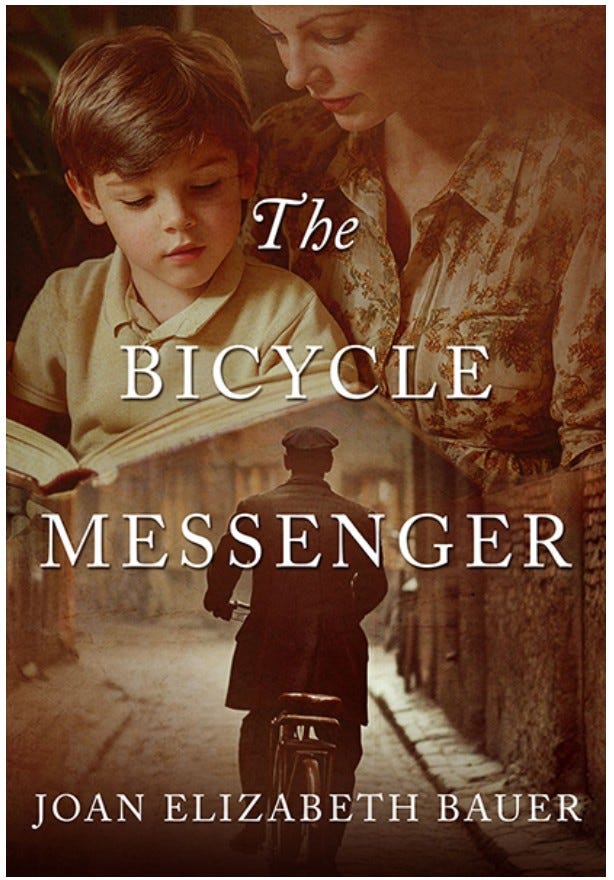
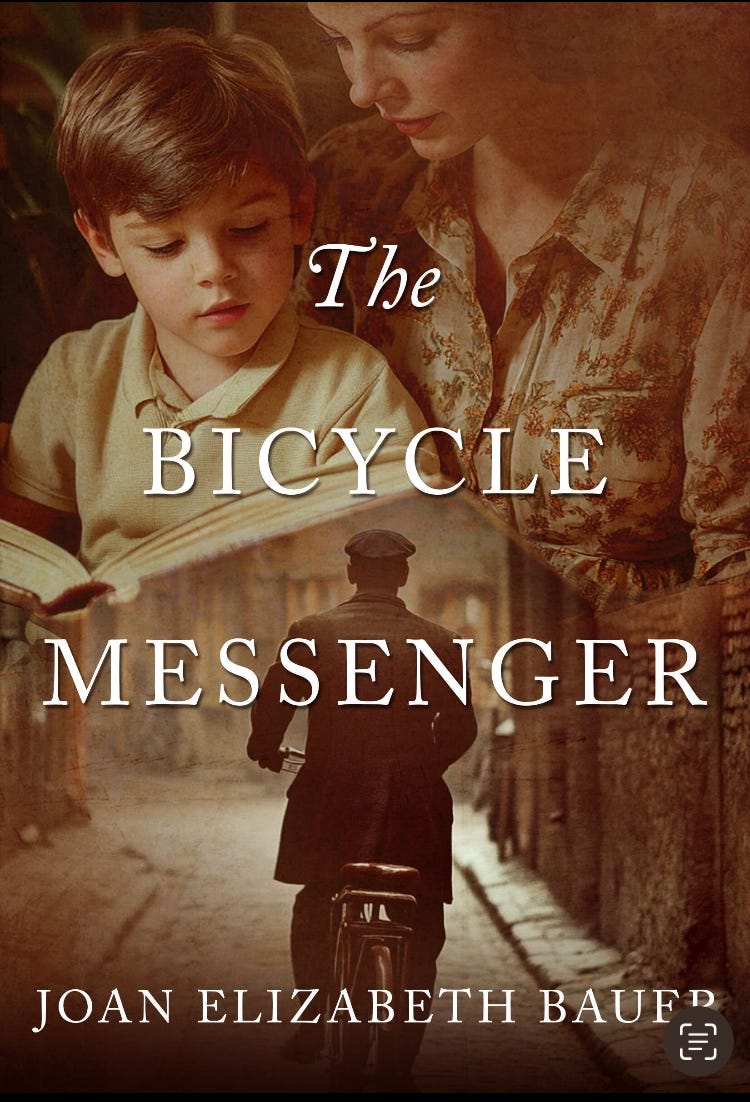
One more sneak peek at The Bicycle Messenger

Recent Reads

Aug 01, 2025

It’s almost here! The Bicycle Messenger releases in just a few days! I can’t wait to share it with you. In the meantime, here are three takes on baptism in the story.

  1. Seven-year-old Steven Hawley is conditionally baptized because no one can locate his baptismal record. For the rest of his life, Steven wonders whether his baptism really “counts.”
  2. Steven’s mother agonizes in her uncertainty as to whether her grandson, who died in infancy, was ever baptized. Will she meet him in heaven, or will he spend eternity in limbo? Where is God’s mercy in this?
  3. In 1942, a Catholic priest proposes to rescue a Jewish child from the Kraków ghetto in Nazi-occupied Poland. Speaking to the child’s devout Jewish grandfather, the priest says, “if we do not baptize them, they will never survive. They must believe themselves to be Christians if they are ever to pass outside these walls.”

A few words on the Catholic Church in the Nazi Era

In her hauntingly beautiful novel of a young Catholic girl who perished in Auschwitz, author Lily Tuck cites Ronald Modras on the state of Catholicism in Nazi-occupied Poland:

During the German occupation, the Polish Catholic Church was in disorder. The Germans killed several thousand priests. In Rome, Pope Pius XII offered little support, instead advocating compromise with Germany. The Polish primate, Cardinal Hlond, had left Poland and had taken refuge in a Benedictine abbey in Savoy, France, and did not offer spiritual aid to his parishioners. Instead, in a 1936 pastoral letter, Cardinal Hlond wrote condemning the Jews: “It is a fact that Jews are waging war against the Catholic Church, that they are steeped in free-thinking, and constitute the vanguard of atheism, the Bolshevik movement, and revolutionary activity. It is a fact that Jews have a corruptive influence on morals and that their publishing houses are spreading pornography. It is true that Jews are perpetrating fraud, practicing usury, and dealing in prostitution.” (56-57)

These are painful words to read. They do not anticipate that a future great saint and Polish pope will undergo his priestly formation in secret under Nazi occupation; they do not anticipate that St. Maximilian Kolbe, arrested shortly after receiving his brilliant insight into Mary’s announcement at Lourdes—I am the Immaculate Conception—will serve the prisoners of Auschwitz faithfully and in secret as priest and confessor, ultimately offering his own life in exchange for that of a man condemned to the starvation bunker.

But while individual members of the church are prone to sin, the truth of the Catholic faith springs from the person of Jesus Christ. As Thomas Merton writes in New Seeds of Contemplation,

the living Tradition of Catholicism is like the breath of a physical body. It renews life by repelling stagnation. It is a constant, quiet, peaceful revolution against death. … only a gift of God can teach us the difference between the dry outer crust of formality which the Church sometimes acquires from the human natures that compose it, and the living inner current of Divine Life which is the only real Catholic tradition.

Getting back to the question of baptism

As I have noted before, there were many acts of specifically Catholic witness during the Holocaust. In her 1986 book When Light Pierced the Darkness: Christian Rescue of Jews in Nazi-Occupied Poland, Nechama Tec takes a scientific approach to such acts, collating data from numerous personal interviews in order to arrive at a realistic picture of the often-fraught relationship between rescuers and survivors. She tells of one devout Catholic Pole who struggled to reconcile his compassionate impulses with the anti-Semitic sermons he was hearing in church: “‘I am sure to lose both worlds. They will kill me for keeping Jews and then I will lose heaven for helping Jews.’” (146)

Tec makes it clear that not all rescuers intended to rescue anyone; many had their Jewish charges thrust upon them, one way or another. But for members of religious orders or the clergy who set out to rescue Jewish children, the question of baptism takes on cultural and spiritual urgency.

Were Jewish children baptized and saved because the Church wanted converts? Or were these children raised as Catholics because this gave them a better chance to stay alive?

Or both?

In other words, did we baptize them in order to save them — or did we baptize them in order to save them?

While admitting that children accepted into a Catholic institution were baptized, Dunski [a devout Catholic rescuer] said that this was done for safety. By becoming baptized[,] Jewish children saw themselves as Christian and therefore could more easily adjust to their new identity. … Young survivors I interviewed mentioned the comforting and soothing effect that the Catholic religion had upon them. … [T]here are many cases on record showing reluctance to baptize these children without the permission of their Jewish guardians. (141-142)

In writing The Bicycle Messenger, I was intensely drawn to the conflict within the soul of a man who knows that the only way to save a child in his care is to offer her into the hands of a priest whose creed he does not understand. As for the child’s mother—well, if you want her side of the story, you’ll have to read the book.

The Bicycle Messenger on Location

Dog-sitting and old haunts

Recent Reads

Jul 18, 2025

The Neptune Gate at Milwaukee’s Villa Terrace

A very dear friend asked me to dog-sit while she helped her daughter move to a new city post-graduation. Archie is an intelligent poodle/Australian shepherd mix with one blue eye and one brown, and he goes into raptures whenever we haven’t seen each other in a while—as in, when I get up in the morning, or when I return to the house after going outside for a few minutes. Archie loves to ride in the car, so after he’d snoozed at my feet while I worked at my laptop, I took him down to the shores of Lake Michigan to visit one of my favorite East Side landmarks.

Thanks for reading! Subscribe for free to receive new posts and support my work.

There’s an eerie moment in The Bicycle Messenger when Steven and his girlfriend Megan pause outside this magnificent wrought-iron gate to gaze up at a renaissance-style villa perched high on a bluff overlooking Milwaukee’s lakefront. It’s 1992, and the villa’s grounds are neglected; the terraced gardens won’t be restored for another few years. But Steven reports an impossible, visceral memory of having been to the place as a child.

“What’s that?” she asked. “Some great man’s house?”

“It used to be. It’s called Villa Terrace.”

Megan stared up at it. The place reminded her of an opera house, its art deco gate like the cage of an old-fashioned elevator.

“I came here for a concert once,” he said. “Inside the courtyard.”

“You did? What kind of concert?”

“A string quartet maybe? I don’t really remember. It was a long time ago.”

Megan nodded, peering in at the empty fountain. At the top of the gate, Steven said, was a figure of Neptune in bas relief, but he faced the inside, so all you could see from the back was a scalloped seashell. Megan noticed the prongs of his trident extending beyond the semicircular top of the gate, like the oversized minute hand on a cartoon clock—pointing, as it were, to a fateful hour about to strike. She put the strange thought aside.

“The garden was lovely back then—not like it is now,” Steven went on. “There was a water staircase right there in the middle—”

“A water staircase?”

“A waterfall going down those steps, yeah. And the hedges were all sculpted, and it was full of flowers.”

The water staircase in operation

It’s funny how places look different when you haven’t visited them for a long while. My imagination had rearranged this garden somewhat, bringing the fountain with its spouting bronze fish much further forward toward the gate; it quietly resumed its true spot as I paused with Archie to watch a newly married couple wander the garden near the cascading water staircase. According to the placard outside the main entrance, their names were Ulysses and Joanne. Congratulations, you two!

There’s a grand winding road leading up the bluff; and while I’m in my fifties, I’m currently in better shape than fictional nineteen-year-old Megan, who struggled to match Steven’s long-legged pace on that day. I’ll admit, I took some satisfaction in that. As Archie and I approached the top of the hill, a young couple drove past on a motorcycle. The girl on the back held her slim, tanned arms down at her sides; she wore the man’s helmet, while he was bareheaded. To my right, a young man appeared to rise out of the ground: he’d just hiked straight up the bluff on a well-worn path with a notice that said the hill was hazardous for sledding. It looked hazardous for pedestrians, too.

Archie and I turned left onto Terrace Avenue, where a man with a portable grill off the back of his pickup offered to sell us Usinger’s sausage and brats. Villa Terrace was closed to visitors for a private reception, but as Archie and I walked past the caterer’s van parked at the service entrance, I imagined Steven climbing out of a similar vehicle to serve canapes at a similar wedding. He and Megan felt as real to me in that moment as the man with the grill or the couple on the motorcycle.

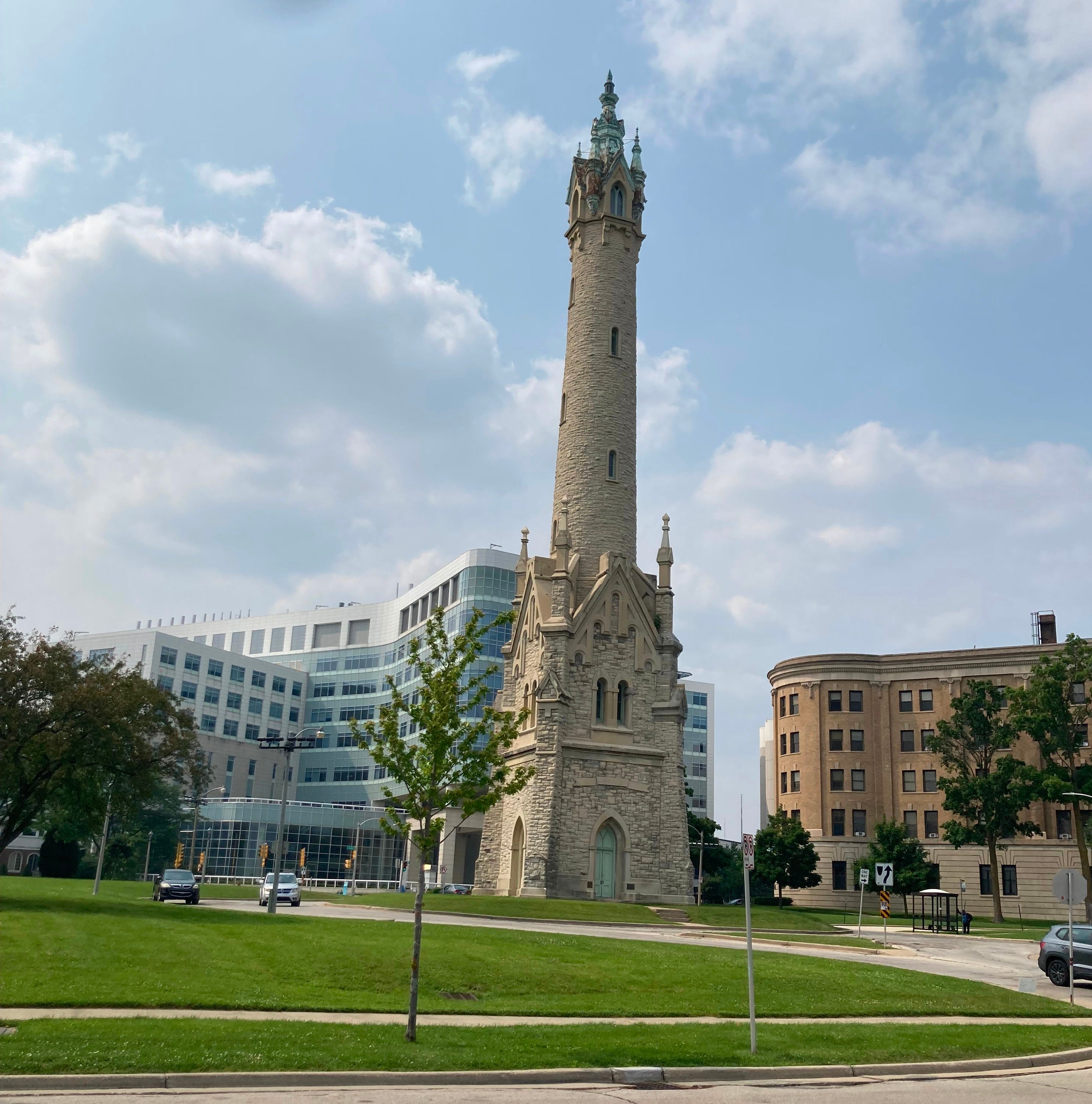
The Nort Point Water Tower, completed in 1874

After visiting Villa Terrace, Megan and Steven would have waited for the bus right about here. It wasn’t until I read Blue Walls Falling Down by Joshua Hren that I learned there was a winding staircase inside this water tower. I’m not sure if visitors are still allowed to climb to the top; dogs most certainly would not be. Besides, Archie was getting tired.

One great thing about dogs—especially other people’s dogs—is that they ask no questions. Thanks for lending him to me, Nancy. We’ll be on our way to the airport to pick you up soon.

Welcome The Stranger

Which of the corporal works of mercy most attracts you?

Recent Reads

Jul 05, 2025

Early in The Bicycle Messenger, Mary Ellen and Charles Hawley learn of the existence of a young relative in need of a home. Seven-year-old Steven has just lost his father to cancer; and according to the silk-stocking attorney who serves as Steven’s guardian ad litem, his birth mother is in no fit state to assume custody.

“This puts you under no obligation, of course,” Mr. Simeon went on. “You are perfectly free to release him to the state’s care.”

“And what would happen to him then?” Mary Ellen asked.

“We would of course exhaust every effort to locate other relatives,” Mr. Simeon replied. “But I can tell you, I think it’s extremely unlikely that we will be successful. If we are not, he would remain in the foster care system until he could be placed for adoption, or until he reaches the age of eighteen.”

Imagine yourself sitting across a polished desk from this man whose cufflinks alone are worth more than your car. What would you do?

I have often been called to welcome the stranger in my life; sometimes I’ve stepped up, and sometimes I’ve hung back. Talk to a new mom on the playground? Definitely a yes. Invite a neighbor who is struggling to find permanent housing to stay in my extra bedroom for a few weeks? Can’t say I ever followed through on that idea. In large ways and small, we all have to discern how to best serve the people closest to us.

According to the USCCB, the corporal works of mercy are feed the hungry, give drink to the thirsty, shelter the homeless, visit the sick and imprisoned, bury the dead, and give alms to the poor. While the directive to welcome the stranger is not listed among them, it can be found in the parable of the sheep and the goats: “I was a stranger, and you welcomed Me” (Mt 25:35). Thus, it is associated with the last judgment and our ultimate place in the kingdom of God. And in practical terms, it maps pretty closely onto the corporal works of mercy listed above.

We all have different charisms that particularly attract us to one or more of these works. Those with the gift of hospitality might excel at lovingly serving the hungry and thirsty, while others who have the gift of consolation might be particularly suited to attend the sick and the dying. In my own writing, I come back again and again to stories of strangers and exiles among us—maybe from guilt, or maybe because of my particular life experiences. Often, it is the missed opportunities or failures that teach us the most.

In The Bicycle Messenger, Mary Ellen and Charles Hawley are called to welcome the stranger into the most intimate relationship of their lives: the family. It wouldn’t be much of a novel if they said no. But as you can probably imagine, Steven’s arrival will change everything.

Which of the works of mercy most particularly speaks to you?

Lately, “Recent Reads” has featured personal essays, but I’m still writing book reviews. You can read my latest, a review of Spare Us Yet by Lucas Smith, in Catholic World Report.

Righteous Among the Nations

A real-life hero appears in The Bicycle Messenger

Recent Reads

Jun 20, 2025

Tadeusz Pankiewicz (photo: Wikipedia Commons)

The Nazis established the Kraków ghetto in Poland in the district of Podgórze in March of 1941, initially cramming some 15,000 people into an area meant to house about 3,000. The previous residents of the district were evicted and given alternate homes or businesses. But one Roman Catholic pharmacist, Tadeusz Pankiewicz, refused to leave: “I understood only too well that the Germans would lose the war, and would destroy my pharmacy, and that I would have to return property that was not mine to its rightful owner or his family when the war ended.”

Pankiewicz was no ordinary man defending his property rights. His business, the “Pod Orłem” or “Under the Eagle” pharmacy, became a locus of communication and aid for the Jewish inhabitants of the ghetto until it was fully liquidated in March of 1943. Pankiewicz’s heroic witness and service to the Polish Jews in the Nazi era would prove to be of incalculable value.

In his memoir of the years he spent among the Jewish detainees, Pankiewicz writes with quiet compassion of the many gatherings he hosted and of the underground intelligence that passed through his pharmacy. “[E]very single room was full of friends, especially in the back rooms, whence it was easy to escape through the exit. It is hard to take in the fact that people managed to do it….” When the ghetto was divided in December of 1942,

The dividing line ran right in front of my pharmacy, which ended up in ghetto B. … [T]he inhabitants of ghetto B were all unemployed, generally poor people with nothing to live on. … They occupied empty flats and deserted buildings. Most of them had never been outside the village where they were born and they had never seen a large city in their lives before. … I tried to approach them to find out more about them, but they were like bears trapped in a cage, endlessly walking the length of the barbed wire fence and begging the passers-by in ghetto A for a piece of bread. … Many of them were barefooted, but it was the middle of winter, there was frost on the ground, it was cold indoors and the water in the pipes had generally frozen.

Pankiewicz received word in January of 1943 that the Germans intended to close his pharmacy, but he did not back down.

I presented my case and was given the necessary papers for the SS und Polizeiführer. I now had it in black and white—the closure of the pharmacy would have a detrimental effect on the health of the ghetto residents, and if the Jews were denied medicine, the ghetto would become a hotbed of diseases and epidemics which not even the ghetto walls or barbed wire could contain.

Pankiewicz’s Catholic faith plays a small but crucial part in the fictional Holocaust narrative embedded in The Bicycle Messenger—a narrative that will eventually illuminate many long-standing questions for the book’s present-day characters. In this brief exchange, a desperate young woman approaches Pankiewicz for a sedative for her mother, who has received a great shock:

My eyes filled with tears. The pharmacist reached across the counter and took my hand in both of his. He looked me right in the face, and then a change came over him. I was sure he remembered me because he looked from me to the baby in my arms.

“Does she cry a lot?” he asked.

“She has terrible colic.”

He nodded again, then he turned to search in the drawer behind him. “If the Gestapo come,” he said, “give her this.”

“What is it?”

“Just a small tranquilizer. It will soothe her so you can keep her quiet until they leave.”

An excerpt from The Bicycle Messenger containing this passage was originally published in Last Syllable. You can find it here or on my website, along with some of my short fiction and book reviews. I look forward to sharing the whole book with you August 4!

It’s Almost Here!

On the long wait

Recent Reads

Jun 06, 2025

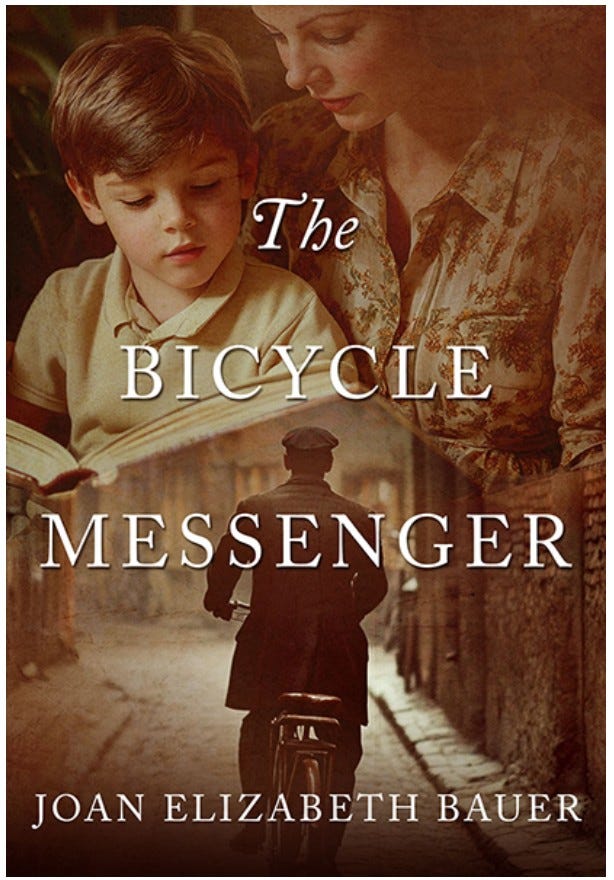
My debut novel, The Bicycle Messenger, releases at the beginning of August! You can preorder the book here to read the first chapter. In the meantime, take another look at this gorgeous cover art designed by the talented Roseanna White:

The book crosses decades and continents. In the 1970s, Charles and Mary Ellen Hawley adopt seven-year-old Steven when his mother, who suffers from schizophrenia, is unable to care for him. Years later, Steven’s quest for the truth about his family of origin plunges him into the dark history of the Nazi occupation of Poland. But first, Steven falls in love—though his own mental illness impinges upon his burgeoning relationship. In this snippet, Steven’s girlfriend Megan becomes increasingly uneasy as Steven recounts a youthful drunken escapade:

Megan was beginning to wish that Steven hadn’t told her these things. The giddy teenager who’d stepped out of the forest like a wood sprite to gloat over past mischief had withdrawn just as quickly as he’d come; but he frightened her as though she had encountered a magical creature, a shape-shifter whose true nature was something dark, wild, and raging.

Who is Steven Hawley, really? And can Megan stick around long enough to find out?

Publishing a novel has been my life-long dream—ever since my mother used to send my childhood scribblings to her brother, a Jesuit priest, for his amusement. My Jesuit uncle visited every year, and once, he brought a friend who taught English at the university level. This dear friend of his sat down with me for half an hour to analyze the opening paragraph of a Nancy Drew knockoff I’d written (“The Case of the Crystal Swan,” complete with illustrations). I was probably twelve. He’d redlined that first paragraph thoroughly. But then he told me: “you have something here. I can feel it.” Imagine that busy Jesuit, a college professor, taking the time to read and analyze the work of his friend’s twelve-year-old niece. Imagine my uncle taking the time to share it with him. All these kindnesses helped me to see myself as a writer speaking to readers when I was young.

Later, when I was in college, I gave a short story of mine to a friend to read. This friend had done a summer writing workshop somewhere—let’s say it was Harvard. I had a terrible crush on him at the time. He smoked way too much and stayed up all night writing plays that were performed on our campus. He wrote songs and played lead guitar in a band. He tried to explain to me that my story had no structure. He took a sheet of paper and drew a straight line interspersed with the occasional little clump of what looked like mashed potatoes. “This is your plot,” he told me. “There’s no rising action, no crisis.”

I wasn’t sure I entirely agreed with that tough critique; and yet I continued to drift, writing mostly in secret. It took me years to develop a voice and find something to say. Thank God for my husband Paul, who listened and read and understood the effort I was making, helping me to improve even as he crafted his own beautiful novels. (You can read more about Paul’s work here). I’ve already told this story about an agent who eagerly read a previous manuscript of mine but ended up wishing the main character would get hit by a bus. I managed to laugh about that one eventually. Still, after a lot more rejections, I started to worry. What if I never found a way to bring my books into the world? Could I be content if no one else read them but God?

When the Song of Songs speaks of the beloved as “a fountain sealed, a garden enclosed,” I think of Mary’s hidden life in Nazareth, of her perfect surrender of her life and her will to the Lord, who is the true reader of hearts. Even if a book is never published, I thought, surely the writing of it under His tutelage would form me in some way to do His will more faithfully.

But as we all know, Mary’s hidden life produced beautiful fruit; and a book, which is also God’s gift, is meant to be read. A book without a reader is like an empty dish, a cup that will never be filled, a garden enclosed that never bears fruit. I’m so grateful to my husband for reading for me all these years. And I love to read and promote the work of contemporary Catholic novelists and poets, because good writers need faithful readers who will bear witness to the beautiful work God is doing in them. Perhaps our job after all is simply to hold out our cups, cracked and flawed though they might be, and trust God to fill them and find the right way to share them. I’m so honored that my debut novel found an award-winning Catholic publisher in Chrism Press. It was well worth the wait. And I give thanks that, with their help, I can soon share the fruits of my own little garden with you.

Is it Nostalgia?

On novel-writing and obedience.

Recent Reads

Feb 20, 2025

Over the past month, I’ve worked on the line edits for my novel, The Bicycle Messenger, which releases in August. The book’s action spans more than seventy years, and parts of it were written in different seasons of my life, so I’m especially thankful that God in His infinite goodness created editors. For me, preparing this manuscript for publication has been a useful exercise in obedience.

Like most writers, I sometimes struggle to “kill my darlings.” We can get too attached to our work, cherishing and repeating certain sentences to ourselves until we can no longer recognize problems. (Hopefully, the short-form immediacy of Substack will help me out here.) To read one’s own manuscript and find such a cherished sentence pared back or even deleted can put us through the five stages of grief—even though we know in our heart of hearts that the editor is right. But that’s really just pride, and the cure is obedience. God does not give us the last word on our own work or even our lives. We need one another—we need Him to complete this work in us. The sooner we realize this, the sooner we can bear fruit.

While some scenes had to be trimmed, others required cultivation. The novel opens in the 1970s, and to help ground the reader in the historical moment, I embarked on a joyful scavenger hunt through my own childhood. I watched clips of favorite TV shows like Mary Tyler Moore and Carol BurnettABC’s Afterschool Special and early episodes of Sesame Street. Kudos if you can remember an orange on Sesame Street singing an aria from Carmen! * By the way, did anyone else have that whiplash effect watching present-day Sesame Street with their own kids? The pacing has quadrupled at least!

Choosing children’s books to include was even more fun. My mother used to read us The Snowy Day by Ezra Jack Keats. Like Sesame Street, that picture of a little boy in a red snowsuit leaving blue footprints in the snow evoked urban wonders in my suburban Omaha childhood. Here in Wisconsin, we’ve had a dry winter, but last week, there were three snowstorms in as many days. As the first storm approached, I was reviewing a scene in which my characters step off a slow-moving bus late at night to walk home through the accumulating drifts, and by the time one of them sank into a hot bath, my wonder returned. For the first time since I can remember, I couldn’t wait for the snow.

There was nostalgia in this, of course. But rereading my own work with the editor’s subtle improvements produced an almost trancelike effect. The text was just different enough that it could surprise me again, and I found myself inhabiting the action and empathizing with the characters in new ways. The scenes I once tapped out at my dining room table have somehow taken on life and become a whole novel; little improvements in pacing have set off miraculous new effects, like snowflakes swirling down in the cone of light from a streetlamp. God is good. Obedience leads us to freedom.

*Good catch, Karen!

I thank my God every time I remember you … being confident of this, that he who began a good work in you will carry it on to completion until the day of Christ Jesus.

Philippians 1:3, 6

Recent Reads -January 2025

In which I take Holly Ordway’s Advice

Last November, at the Well-Read Mom annual conference here in Milwaukee, Tolkien scholar and Word on Fire author Holly Ordway spoke to us on “How to be Adventurous, Wise, and Charitable as a Reader.” Among Dr. Ordway’s suggestions was to sample various genres beyond the ones we usually read. This recommendation dovetails nicely with the mission of Chrism Press, which “seeks Spirit-filled fiction in all genres,” including romance, gothic horror, science fiction, and fantasy. I’m especially excited to promote Chrism Press, because in August, they will publish my debut novel, The Bicycle Messenger.  I’ll have more to say about that in an upcoming post. But in the meantime, here are three great Chrism Press titles you’re going to love.

Romance: Love in the Eternal City by Rebecca W. Martin

I was first attracted to Rebecca Martin’s writing when I heard her speak on a LegendFiction panel (you can find it here). She just sounded so likeable—and as it turns out, so are her characters. Elena, a young American journalist, has just accepted a public relations job in Rome after her former engagement to Chris goes up in flames. Elena is wounded, of course, but not bitter; she’s fresh and candid and eager to embrace all the potential of her new life—beginning with her friendly landlords, Paolo and Angela, who rent her a charming apartment above their tabaccheria.

Elena isn’t looking for love when she meets Benedikt, a handsome Swiss Guard, in the Campo Santo Teutonico. But Benedikt’s exuberant stepsister Rianna quickly befriends Elena, providing her with a good opportunity to get to know Benedikt too. And soon, they are working together on a major fundraising gala. Like Elena, Benedikt is discerning his future life; his wealthy father wants him to take over the family business, but Benedikt loves being a Swiss Guard and would like to advance. Beni and Elena are surrounded by a delightful cast of mentors-turned-matchmakers, starting with Rianna and going all the way up to the Holy Father himself.

Love in the Eternal City includes a frank and sensitive portrayal of Elena’s struggle to maintain good mental health. Thanks to Martin’s generous authorial voice and the goodness of her characters, we do not fall into depression alongside Elena; instead, we develop our empathy as we read. When Elena’s former fiancé interferes in her life once again, Elena finds herself snapping at Beni almost against her will: “the bitter voice has strangled the true one.  … My life is a self-fulfilling prophecy. I’m letting the man who hurt me drive away the man who cares.” Elena really struggles to be loving toward Beni when she’s depressed. It’s here that her attempts are most worthy and admirable, even when she fails. I could easily imagine Christ coming nearer to her in these scenes, sending her people who care.

Meanwhile, Beni protects the pope as he goes incognito to minister to immigrant families at a local children’s hospital. But as it turns out, the one who goes to protect the Holy Father is the one who receives a grace he didn’t even know he needed. Beni is honest with the pope about his trouble with his father. In return, the pope offers a diagnosis: “The anger isn’t his problem; the anger is your problem. You’ve never forgiven him for the piecemeal abandonment after your mother died. Maybe you’ve never even forgiven him for his own grief.” The pope hears Beni’s confession, and he is so insightful that Beni wonders if he was once an intelligence officer. There’s a lively bit spy-craft to enjoy in the book’s dénouement.

Gothic: Wake of Malice by Eleanor Bourg Nicholson

Wake of Malice reminds me of a BBC police procedural featuring a setting like Oxford or a priest turned detective—in other words, someone should option this book for a miniseries, and soon. It’s 1908, and Hugh Buckley–gentle and portly, haunted by the memory of his harsh Irish mother—lives in London and writes for the Pall Mall Gazette. But when a priest is accused of embezzlement, Hugh and his thoroughly English photographer colleague Frederick Jones are sent to the village of Doolin in Hugh’s native Ireland to cover the story. “Could the mere mention of Ireland bring back the nightmares of my childhood?” Hugh wonders. “London had seemed such a safe, impersonal place.” And before they even arrive, the crime escalates to gruesome murder.

The mysterious land of the Burren and the Cliffs of Moher reawakens Hugh’s Catholic faith, which he has long tried to suppress. Some of the locals, especially the women, have been meddling with the occult, grafting superstition onto their practice in a dangerous way. “‘There are some fierce and fiendish women hereabouts,” Hugh says to Freddie. “I’d be afraid to meet Mrs. Gorman of a night, especially if you happened to have squashed her favorite illicit tradition’”—i.e., a pagan festival that is quickly canceled by Father Brendan O’Connor, a stern Jesuit priest who takes over the parish while the local pastor, Father Michael James Walsh, is being investigated.

Hugh knows all the ancient legends, but he still makes the mistake of crossing a wide field, where he is bitten by a tiny, mysterious creature. The wound troubles him for weeks until it comes to the attention of Father Thomas Edmund Gilroy, a smiling, bespectacled Dominican priest who has come from England to support his beleaguered priest friend. Father Thomas Edmund has useful experience dealing with the occult. But at first, Father Brendan O’Connor refuses his help.

Wake of Malice features all sorts of colorful characters, including the haughty and beautiful Doireann O’Hara, granddaughter of the first murder victim; a good crop of local gossips in the pub where Hugh and Freddie are staying; and a group of Romanis who will lend a hand at the appropriate time. More murder victims pile up, some of them fearfully mutilated, their bodies surrounded by gold coins. The two journalists feed copy and photographs to their boss at home in an effort to extend their stay, because both Hugh and Freddie are becoming part of the local fabric. Hugh begins to dream of the farm life he once enjoyed, even delivering a calf for a cow in distress. He eventually admits to Father Thomas Edmund that he stopped going to mass after his mother’s death. “When she died…well, in London, no one woke me or beat me or fretted me anymore. On a Sunday morning, I found I slept well and deeply, and no one roused me. And…well, it seemed a much less frightening existence.” Life became “dull and safe.” But as Father Thomas Edmund assures him, “You aren’t the sum of your poor mother’s fears. God in His graciousness will supply your every need. Stop hesitating and let Him.”

Wake of Malice is a rollicking read that features lots of clever dialogue and even a bit of romance, along with sinister forces that need defeating.  Eleanor Bourg Nicholson delivers it all with a good dose of humor.

Fantasy: Misshelved Magic by S. R. Crickard

In Crickard’s debut novel, Adelina is a plucky librarian who often feels overlooked, and Leon is a talented student of magic who needs a topic for his senior thesis. Adelina is assigned to the history department of the library, where she is strictly enjoined to stay away from the barrier of glowing stones that demarcates the spell section. But one little magical book keeps finding its way to her shelves, and when Adelina tries to return it, she finds herself face to face with a cervara, one of a group of magical creatures who protect and defend the spell section of the library. Adelina longs to befriend the cervara; they seem so lonely in there, and she’s a curious person.

But as we soon learn, an epic battle between good and evil is raging in this little place. Crickard has a very light touch, but she draws deeply on rich images from salvation history. Adelina’s visits to the spell section brought to mind Dante’s Inferno—or, rather, Purgatory, with the cervara as the poor souls who must atone for a particular sin they have committed during their earthly lives. The First Spell that has ruined the cervara stands under lock and key in the grove at the center of the spell section of the library, rather like the tree of knowledge of good and evil in the lost garden of Eden.

But just as original sin affects all of fallen humanity, the pull of the First Spell works its way into Leon’s mind. One of the things I love about his book is the way it enacts temptation—specifically, the temptation the serpent poses in the garden: you shall by like gods. Leon is an extremely promising student, but he is plagued all along with feelings of inadequacy, and in a moment of crisis, he is tempted to hubris. Like the cervara before him, Leon believes he can wield the First Spell without succumbing to its danger. “The spell needed him. The king and the college would see his worth. He’d be invincible, and no one would ever question him again.”

But as any good reader of fantasy knows, the solution to the word’s problems is not to be found in magic. This book has profound things to say about the importance of embracing our humanity through literature instead of trying to overcome it through technology or our own strength, represented by magic. As Leon says to Adelina, “I can write spells that alter or conjure things, but your poems bring understanding.”

Recent Reads – December 2024

Shop Local

Fire Conditions by Thomas C. Malin (WWA Press, 2024)

I love to celebrate the work of small presses. This fall, the Wisconsin Writers Association has released Fire Conditions, a coming-of-age novel by Thomas C. Malin.

One of the things I admire most about this book is its strong sense of place. Set in the nineteen-fifties in the town of Friendship in Adams County, Wisconsin, Fire Conditions is the story of Mike and his younger brother Jimmy, who travel from Chicago to spend the summer with their grandmother while their parents work out some difficulties in their marriage. Along the way, Mike joins a club called the Big Fish People, builds a fort, has his first kiss, and looks out for his little brother. But there are dangerous forces at work, even in Friendship; and soon, Mike must determine what kind of man he is going to be.   

Friendship is chock-full of colorful small-town characters. Readers who grew up on The Magic School Bus series might recognize a nod to Miss Frizzle in Grandma Flowers’ colorful dresses printed with daffodils or purple iris. When the sirens wail in the middle of the night, Grandma Flowers scrambles the children from bed to try and beat the sheriff, who is also her boyfriend, to the scene of a fire. Having ceded her entire house to her dogs and her parakeet Pookah, Grandma Flowers houses the boys over the bar she runs. This is in stark contrast to the boys’ other, wealthier grandparents, who have built a fancy compound on a nearby lake.

Grandma introduces the boys to her friend Lena, who lives in a remote place and just might be a Wiccan; and while this troubled me at first, Malin gives us a sensitive treatment of religion elsewhere in the book. He presents the town’s Lutherans and Catholics without caricature, and when the boys attend their first church funeral, Mike wrestles with questions of belief in an age-appropriate way. Similarly, Mike acknowledges the prejudices of some of his elders without sharing them. Malin brings a light touch to Mike’s friendships with Goose, a member of the Ho-Chunk Nation, and Will, who has lost his mobility to polio. The story beautifully evokes boyhood in the nineteen-fifties: readers will love to imagine themselves out in the woods building forts or going to club meetings without constant parental supervision.

Of course, any book that features a fire-chasing grandmother with her own pistol is bound to end up in adventure and danger, and Fire Conditions does not disappoint. There is plenty of peril and mystery to go around. But near the end, there is also an unexpectedly moving and delicate portrayal of the aftermath of childhood trauma. Fire Conditions is a delightful sojourn “in the town called Friendship, its first name being Adams, where we Big Fish People played and worked and cared deeply about each other.”

Recent Reads – September 2024

A Look Back at Summer

Child of my Heart by Alice McDermott (2002, Farrar, Straus and Giroux)

A Month in the Country by J. L. Carr (1980, reissued by New York Review of Books in 2000)

Word on Fire’s Women of the Catholic Imagination: Twelve Inspired Novelists You Should Know is the gift that keeps on giving. When I reviewed it here in July, I was only familiar with half of the novelists featured, leaving me with an excellent list of good things to read. Since June, my husband and I have visited six used bookstores in four different states, where I’ve been cruising for titles by Muriel Spark and Alice McDermott.

Set in what might be the nineteen-seventies, McDermott’s Child of my Heart is the story of fifteen-year-old Theresa, an only child growing up in Long Island among the summer homes of the rich. Theresa is beautiful and on the cusp of adulthood— “I believe my parents had grown a little wary of me by then” –and she works tirelessly all summer, caring for children and pets while her mother and father commute to the city. In addition to her paying clients, Theresa keeps an eye on Petey Moran, one of a large and neglected brood of children living next door. Petey spends enough nights sleeping in the yard outside Theresa’s bedroom window that her parents have considered calling Child Protective Services. But in the morning, they just give him breakfast, pretending he’s only dropped over. Daisy, an eight-year-old cousin, arrives from Queens Village to stay with Theresa for a few weeks, bringing a suitcase full of brand-new and ill-fitting outfits and one very special pair of impractical shoes. Theresa takes Daisy up to the attic, where her own parents have preserved all of her childhood clothes. As they pick out a few things for Daisy to wear, Theresa lays claim to the memory of a prior existence. “’You don’t remember God?’” Theresa asks. “’Or heaven? Or the angels? Or the other children waiting to be born?’” When Daisy demurs, Theresa goes on to insist that she has always remembered the name of a brother of hers who had died before she was born. “Clearly, I said, my brother and I had met, and exchanged names, sometime between his birth and mine.”

Theresa takes Daisy on her rounds, walking dogs and picking up Flora, the toddler daughter of an elderly artist and his beautiful, vulgar wife. Early in the novel, Flora’s mother takes off for the city, leaving Flora in the hands of a jealous French maid who sets her out on the porch every morning strapped in a stroller, a bottle of Hawaiian Punch hanging out of her mouth. Theresa cares tenderly for Flora, but she also attracts the attention of Flora’s father, who spends most of his days in his art studio drinking. Other men leer at Theresa as she minds their children on the beach or by the pool.

There were things in this book that had never occurred to me, and things in which I immediately saw myself. In the mornings, Theresa eats peaches on the front porch while she finishes her book, rinsing her hands and mouth with dew. A lover of Shakespeare, she nicknames a pair of twins Cobweb and Peaseblossom, and she invites Daisy to do fanciful things that are not done at home. Eat the center out of your English muffin with jelly, she tells her, and then wear it like a ring so you can nibble it later. When a dog takes it from her in one bite, the day is sealed in her memory, along with its heat and freedom and promise. Theresa knows in her heart that something is desperately wrong with Daisy. But if she tells anyone, Daisy will have to go home.

The elderly artist, meanwhile, wonders whether he has made anything that will last. Most of his work is ugly and abstract, but three beautiful mother-and-child drawings hang above Flora’s crib—drawings that belie the neglect of the mother, the cupidity of the father.

I glanced at the three sketches in their gold frames and considered what their worth might be, when they had been claimed by the future and all that was pretty and charming about them was transformed by all that had intervened—the infant grown into a troubled woman, the mother never returned, the father and all his efforts turned to dust. But then, I supposed, with more time, all that would be forgotten as well, and they would once again be charming and pretty portraits of a mother and child—not a biography, as Macduff might have said, but a novel.

I found I preferred modern art, pictures of nothing, after all.                

This may sound a bit jaded, but perhaps it is only the speech of a prescient young woman who has seen through a weak older man. Near the end of Daisy’s visit, Theresa sees Daisy “carrying [a] gaudy kite on her back to keep the wind from bending it. A modern-art version, it seemed to me, of angel wings.” She is not the only one who comes to love Daisy on her short visit; long after the cataclysm at the end of the book, Petey Moran brings a box full of baby rabbits over to Theresa’s house.

I knew without asking that this was Petey’s gift, indistinguishable as it was from a burden. Petey, who always used to ask, challenging and pleading at the same time, ‘Do you like me? Do you like my family?’ Who had wept with his fists tight. Who would be plagued all his life by anger and affection, by gifts gone awry, by the irreconcilable difference between what he got and what he longed for—by the inevitable, insufferable loss buried like a dark jewel at the heart of every act of love.

Like Child of my Heart, J.L. Carr’s A Month in the Country captures the fleeting essence of a long-ago watershed summer. I don’t know if Carr is considered a religious writer; but in this 1980 novel, he takes up questions of faith, sectarianism, and the power of art to bring us closer to the Divine. As Michael Holroyd puts it in his introduction, “A Month in the Country is a novel of resurrection.”

Shortly after the Great War, Tom Birkin, an art restorer and veteran with a severe facial tic, sets up residence in the belfry of a church in the village of Oxgodby, in Yorkshire. He has been hired by the vicar, John Keach, to uncover a medieval mosaic of the Last Judgment. A local widow has left a bequest to the church on two conditions: 1) restore the mosaic, and 2) find the grave of an ancestor of hers who was buried outside of consecrated ground. A man named Moon, who is employed for this second purpose, is secretly mapping out the foundational remains of an ancient basilica with the intention of publishing his findings—though he will get around to locating the ancestor eventually. He lives in a tent on the property and befriends Birkin as a fellow veteran of the war.

Tom’s work attracts frequent observers, including the fourteen-year-old daughter of Mr. Ellerbeck, the stationmaster. Soon, Tom is invited to tea at the Ellerbeck home on Sunday afternoons; he finds himself recruited as an umpire for cricket and as an assistant at Sunday school. Mr. Ellerbeck doubles as a Wesleyan preacher, and once, when he is expected to visit three far-flung churches in a single day, he sends Tom Birkin himself as a substitute. This fraternization with the Wesleyans earns Tom no points with the Reverend Keach, whose beautiful wife Alice also visits Tom at his work.

Carr’s book deliberately recalls Thomas Hardy’s portrayal of life in the English countryside. Near the end of the summer, Tom joins a hay wagon ride—a “Sunday school treat” for the Wesleyans—that might have been lifted from the pages of Tess of the D’Urbervilles.

And so we clattered off, calling farewell to those disqualified by infirmity or alien beliefs from joining us, conscious (as they were) that we were part of the ancient cycle of the farming year and that our passing was token that the harvest was almost in.

Tom, whose own wife has left him, falls in love with Alice Keach, prompting the vicar to pay Tom what he is owed and dismiss him from the work. Tom counters that, if he is forced to leave now, he will tell the lawyers he was prevented from finishing, voiding the widow’s bequest. But while Tom’s love for Alice necessarily entails a denial of Keach as a man, the vicar has the last word.

The English are not a deeply religious people. … They do not need me. I come in useful at baptisms, weddings, funerals. Chiefly funerals—they employ me as a removal contractor to see them safely flitted into their last house. … But I am embarrassing you, Mr. Birkin,’ he said. ‘You too have no need for me. You have come back from a place where you have seen things beyond belief, things which you cannot talk of yet can’t forget, but things which are at the heart of religion.

Tom has numerous meaningful encounters in Oxgodby, but there’s an argument to be made that the key relationship in the book is between Tom and the unknown artist who created the mural. “Who was he? I couldn’t even name him. People don’t seem to understand those far-off folk. They simply weren’t us. Our idea of personal fame was alien to them.” But here is Tom, packing to leave and mourning the end of the summer:

Last of all, I gazed beyond the scaffolding to the great painting half hidden in the shadows. Truthfully, I felt nothing much. …Then (and I can’t explain it) the numbness went and I knew that, whatever else had befallen me during those few weeks in the country, I had lived with a very great artist, my secret sharer of the long hours I’d labored in the half-light above the arch.

Tom might not describe this as a religious experience, but what else could it be? He is attracted, even transformed, by the good, the true, and the beautiful–and by the end of a marvelous watershed summer.

Recent Reads – July 2024

In Search of Community

Haley Stewart, Ed. Women of the Catholic Imagination: Twelve Inspired Novelists You Should Know (Word on Fire, 2024)


An as-yet unpublished novel of mine once found its way into the hands of a literary agent for consideration. It’s about a young woman in a high-powered job who is unfaithful to her husband and makes quite a mess of her life. In a moment of crisis, she enters a church, where she has a transformative encounter with a Catholic priest.

I waited eagerly for the agent’s response. And while the answer was no, she kindly offered her feedback. Though she had wanted to like my book, she thought the pivotal scene with the priest was ridiculous; and by the end, she disliked the main character so much that she wished she’d get hit by a bus.

Needless to say, I went back to the drawing board. But for years after that, as I sent out my writing, I tried to keep my Catholic faith under the radar.

How wonderful, then, to discover that a vibrant culture of Catholic writers and publishers was already emerging right under my nose. My first real inkling came from a Facebook post promoting Katy Carl’s novel, As Earth Without Water (Carl’s essay on Rumer Godden is featured in Women of the Catholic Imagination). I was astonished and thrilled to read such a nuanced and beautiful story of an artist discerning a religious vocation. And as it turns out, there are many excellent works of fiction in this vein, both contemporary and classic. Some of them I knew, and some, I didn’t. For instance, did you know that Nobel-Prize winner Toni Morrison was a Catholic, and that her books can be read fruitfully in this light? How about Donna Tartt, who won the Pulitzer Prize for The Goldfinch?

Women of the Catholic Imagination not only delineates the Catholicity of some of the writers we know; it also introduces many once well-known writers whose work still deserves to be read. According to Bonnie Lander Johnson, British novelist Alice Thomas Ellis’s “large and eccentric Gloucester Terrace household was well-known for its conflation of home life, writing, painting and publishing; in this convergence of activity, Ellis’s home has been compared to the Bloomsbury Group.” I’ve just finished the first book in Ellis’s Summerhouse Trilogy, and it’s great. Julia Meszaros has this to say about Caryll Houselander: “the artist [is] perhaps the last person left to witness to the beauty of doing something for its own sake, no matter the cost.” And I’d never heard of German writer Gertrud von le Fort, but Helena M. Tomko’s description of her accords with my own experience of writing fiction:

’Creative power can only be received,’ writes le Fort. She sees this as a feminine capacity and corrective to the masculine impulse toward ‘self-redemption’ and self-creation. Her understanding of Marian co-redemption is exemplary for men and women alike, who ‘must conceive the creative spirit in the sign of Mary, in humility and surrender, or he [and she] will not receive it at all.’

As you may have already gathered, Women of the Catholic Imagination is full of great writing. Dorian Speed introduces Scottish writer Muriel Spark like this:

Half a century before Jim Carrey walked off the set of The Truman Show or Will Farrell negotiated with the novelist pulling the strings of his life story in Stranger than Fiction, Caroline Rose (a Spark character) heard her own thoughts being typed out by an unseen author.

How cool is that? I recently attended a Catholic Literary Arts panel called “Writing While Catholic,” and Dorian Speed, who was one of the panelists, characterized good fiction as a place where wounded characters receive God’s grace through their interaction with others. This exactly describes the kind of stories I want to write and read.

In addition to the writers mentioned above, Women of the Catholic Imagination includes essays on Josephine Ward, Sigrid Undset, Flannery O’Connor, Caroline Gordon, and Alice McDermott. By my count, seven of the twelve writers featured are Catholic coverts and one is an English recusant, so there’s a wonderful diversity in their stories of faith.  And beyond that, it’s refreshing to see how many of my favorite contemporary Catholic poets and fiction-writers are also very fine essayists and critics. Some of them, including Eleanor Bourg Nicholson, Katy Carl, and Joshua Hren, contributed essays to this book. Women of the Catholic Imagination is a great place to meet these writers, too.