Clover Connell is no Peter Pan. And yet.
Jul 01, 2026
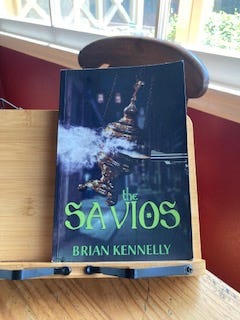
I’m pleased to tag #OpenBook Linkup on CatholicMom.com. Thanks to Carolyn Astfalk for hosting this opportunity!
No one learns to fly in Brian Kennelly’s new novel The Savios, and no one really refuses to grow up. Nevertheless, the story presents us with a Peter Pan problem: in a world of gang violence, how can we rescue our boys? Clover Connell, the Irish gangster who runs South Boston in the late nineteen-sixties, has been luring Father Patrick’s altar boys into his violent Green Kern gang for decades. The two men emigrated from Ireland together as boys, but when Clover gets in line to share what Father Patrick likes to call “the feast of the lambs,” the old priest refuses him communion. Confronting Father Patrick after the mass, Clover asks, “Is it not your vocation to offer the Church’s treasures to poor men like me? Come now, what can I do to receive a penny from heaven, old friend?” But Father Patrick reminds Clover that “[y]our poverty is of your own making.” Father Patrick remains one of the few people in Boston courageous enough to stand up to the old gangster.
Meanwhile, Clover has been recruiting Cullen O’Reilly, an altar boy whose girlfriend Kiera is carrying their child. Disillusioned by a cruel mob hit on his family, Cullen and the rest of Father Patrick’s altar boys form the Savios gang, taking their name from Saint Dominic Savio, the patron saint of altar boys—and, as Father Patrick later points out, juvenile delinquents. The boys are determined to take down Clover Connell and his brutal son Michael, even traveling to Northern Ireland in pursuit of their quarry. But in turning to crime—even in the service of what they call righteous revenge—the boys separate from society and their families and become lost, living like outlaws in a series of secret locations. Only Rory, the youngest and most fragile among them, keeps his hands clean—perhaps because, after a terrible trauma in childhood that leaves him mute, a kind neighbor “pulled a rosary from her pocket and wrapped it around Rory’s hands, as if bandaging wounds on his palms.” The rest of the boys instinctively shield Rory from violence. But it will take much more than the arrival of Kiera, the Wendy figure in this loose analogy, to lead these boys back to a life fit for the Kingdom of God.
Kennelly’s story immerses us thoroughly in nineteen-sixties Boston and Belfast, introducing us to a host of well-drawn and distinct characters. Brandon Murphy is an Irish cop seeking to take down the Kerns from the inside. Cory Dalton is a federal agent sent to commandeer Murphy’s investigation. Various mobsters (not just Irish but Italian), family members, diplomats, and priests move vividly through the story. Most poignant of all is Murphy’s four-year-old daughter Grace, who plants kisses on a framed picture of Jesus every morning, just over his Sacred Heart. Grace’s piety mystifies her father and mother even as it feels like an early indicator of sainthood.
But reader, take note: this book depicts torture and violence, although none of it is gratuitous given its subject. In the disordered society run by the mob, each of the main characters must grapple with the deep darkness that dwells in the human heart. Many innocent people are plunged into bitter grief. But Christ is certainly present even here: in the courage of the priests and in the will to forgive, in the bonds of loyalty between brothers and friends, in the protective instincts of impending fatherhood and in the forethought of a young boy to conserve the Eucharist when a church has been desecrated. And in what is becoming a hallmark of the excellent work published by Chrism Press, the Eucharist guides the quest for a good death.
Kennelly deliverers plenty of heart-pounding tension, and the book’s last several pages turn very quickly. As the story comes to a close, Northern Ireland serves as a strange sort of Never Land: warring factions have torn it apart, and it feels impossible to escape. But for Clover Connell, Northern Ireland will always be home, “half a world away in the green hills.” Kudos to Kennelly for depicting historical conflicts on both sides of the Atlantic so faithfully. The question of saving our boys takes many forms across generations and continents. But as Kennelly shows us, the answer is always Christ.
Saint Dominic Savio, pray for us!

