The joy of reading backwards
Sep 02, 2026
I’m pleased to tag #OpenBook Linkup on CatholicMom.com. Thanks to Carolyn Astfalk for hosting this opportunity!
What comes to mind when you hear the phrase “flying elephant?” Well, for me, the answer is obvious: Dumbo. Who can forget that thrilling Kitty Hawk moment when Dumbo takes off with a great cloud of smoke and a vigorous flap of his ears, casting his impossible shadow over the land? Disney released the original film in 1941; and yet this multilayered cultural reference popped into my head on a reading of G.K. Chesterton’s The Man Who Was Thursday, first published in 1906. If that sounds crazy, take a look at this description of a chase scene from late in the novel.
Through street after street, through district after district, went the prodigy of the flying elephant, calling crowds to every window, and driving the traffic left and right. And still through all this insane publicity the three cabs toiled after it, until they came to be regarded as part of a procession, and perhaps the advertisement of a circus.
I have no idea whether Walt Disney ever read Chesterton; I certainly hadn’t, until recently. As a child of the nineteen-sixties and seventies, I first encountered many of the West’s most enduring cultural tropes via television, advertising, movies, and popular music. It was in some ways a backwards education, a movement from the adaptation to the original; and as a result, I’m always hearing echoes of popular culture in classic works of art. In my defense, though, my used edition of The Man Who Was Thursday, published in 1960, looks like this:
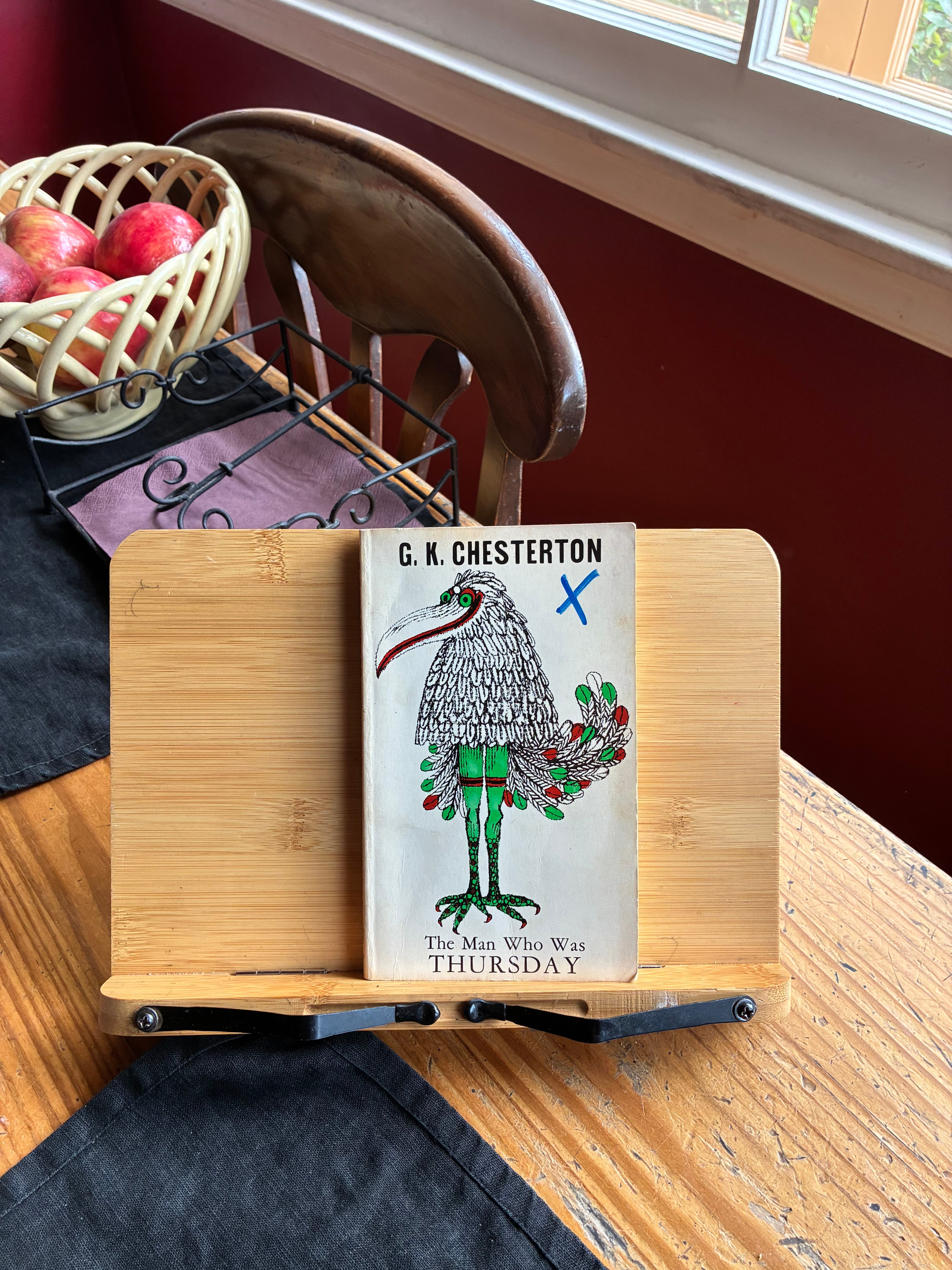
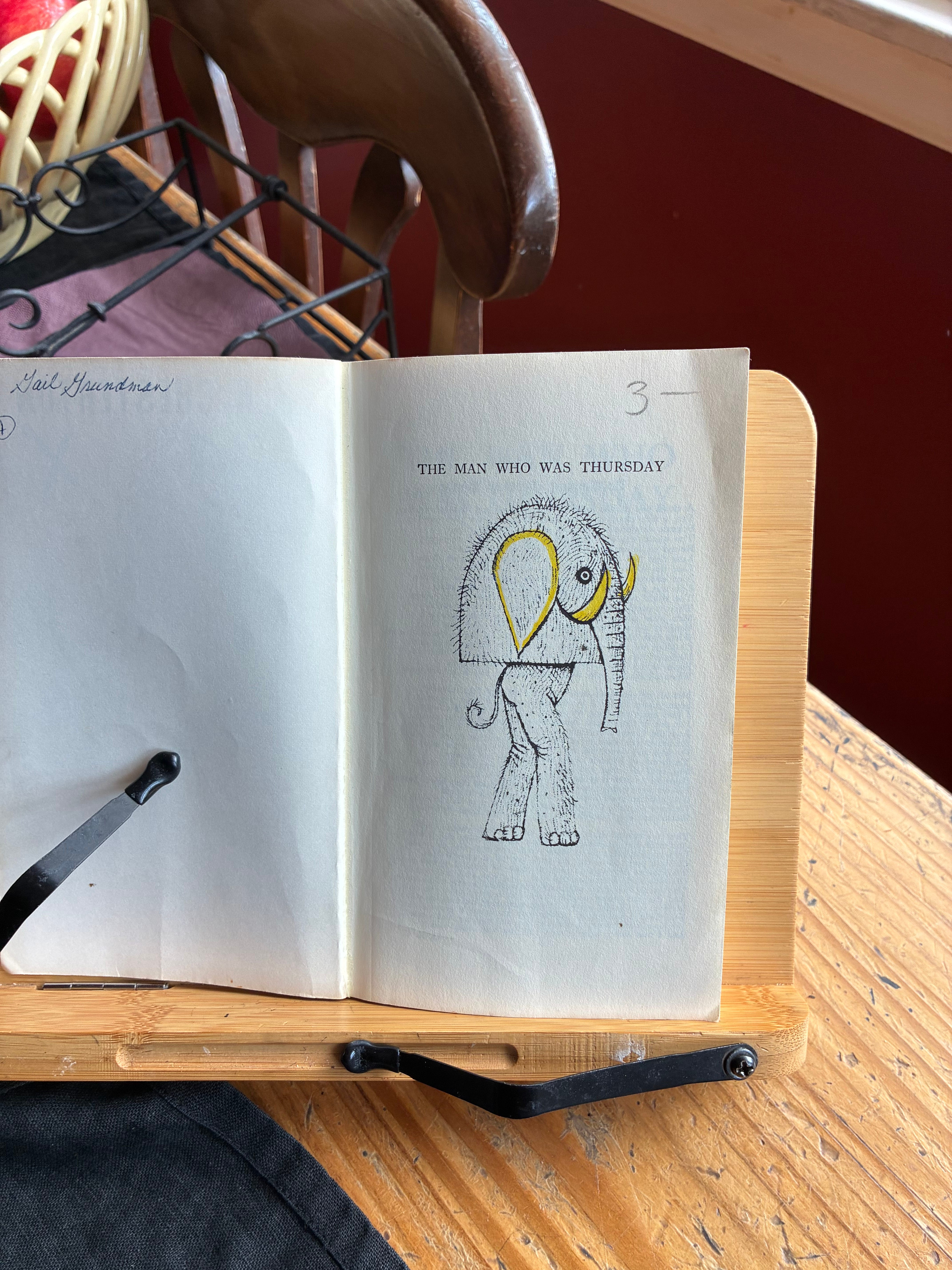
Creepy, right? Fantastical—like Alice in Wonderland meets Godspell. And I’ll venture to say that Chesterton himself might not be too offended by the comparison. After all, he subtitled the story “A Nightmare,” sprinkling it with dizzying moments of unreality, grotesquerie and sheer terror at the strange excuses for men walking around—men in disguises and masks, men who pretend to ideas they actually hate, men who hate humanity itself and bend their efforts relentlessly toward its destruction. As a story of anarchists and the men who oppose them, G.K. Chesterton’s The Man Who Was Thursday feels as fresh today as it must have felt when it was published one hundred and twenty years ago.
A poet-slash-undercover police detective named Gabriel Syme arrives in Suffolk Park, where he challenges the anarchist bona fides of local poet Lucien Gregory. After swearing an oath of secrecy to his new friend, Syme manages to get himself elected in Gregory’s place to the European division of the Supreme Council of Anarchists, where he will act as a spy. The council is composed of seven men code-named according to the days of the week, and Syme becomes Thursday. Led by an unnaturally massive and terrifying man named Sunday, the council meets in plain sight on the balcony of a London hotel. After all, if you proclaim your anarchist tendencies honestly, who will believe you?
Each of the anarchists presents a feature that’s a little bit “off:” a crooked smile, profuse facial hair, giantism, or insanely advanced age. Dr. Bull, also known as Saturday, is fitted with black sunglasses that “took away the key of the face … his eyes might be covered up because they were too frightful to see.” This technique of exaggeration and grotesquerie called to mind the opening scenes of the Amazon Prime series The Steal, in which the conspirators arrive separately to take over a bank wearing grotesquely ugly false faces that, like crude AI-generated images, deliberately fail to fool the eye. Like Chesterton’s characters, the thieves in The Steal appear human, but not quite—they are ugly enough to attract notice while remaining completely unrecognizable once they remove their disguises. It’s deeply unsettling, right? Well, Chesterton did it first.
In the anarchists, Chesterton conjures for us an existential, denaturing peril— “a huge and pitiless peril, like a Chinese invasion.” This threat, however, comes not from without but from within. As Syme puts it,
one of the most celebrated detectives in Europe … has long been of the opinion that a purely intellectual conspiracy would soon threaten the very existence of civilization. He is certain that the scientific and artistic worlds are silently bound in a crusade against the Family and the State. He has, therefore, formed a special corps of policemen, policemen who are also philosophers.
This feels remarkably prescient in our technological age, where various anti-humanist strains of thought seek to undermine the wholeness of persons created body and soul in the image of God. Like Filistrato in C.S. Lewis’s That Hideous Strength, Chesterton’s anarchists seek to separate the intellect (or the head) from bodily life, inciting a similar horror in the reader. The locus of this horror in Chesterton’s book is the huge, dark and mocking figure of Sunday.
[He] seemed like the final form of matter, the most shapeless and the most shameful. …{The] bestial mountain was shaking with a lonely laughter, and the laughter was at me.
Thankfully, though, this figure of Sunday evolves—or perhaps it is the perceptions of him that evolve, for, like many of the characters in The Man Who Was Thursday, Sunday is not quite what he seems. Near the end of the book, Chesterton’s corps of policemen/philosophers has chased the escaping Sunday on his flying elephant all the way to a sort of World’s Fair, where Sunday takes off in a hot-air balloon, just like the Man Behind the Curtain in The Wizard of Oz. This particular cultural reference is not entirely anachronistic, as L. Frank Baum published his book in 1900; but the movie came out in 1939 and did not become part of my personal childhood iconography until the early 1970s. At any rate, as the policemen watch Sunday floating away over their heads, their opinions of him gradually change:
I don’t want him hurt, somehow. said Dr. Bull.
I can’t help liking old Sunday … There is a kind of gaiety in the thing, as if he were bursting with some good news.
Syme is the last of the men to relinquish his horror of Sunday, who by this point has been leering at his pursuers like some sort of crazy clown, as though it were all a joke. Syme realizes that he has been looking at Sunday from the back all this time because he feared confronting him face to face. But when Sunday finally turns,
It was like the face of some ancient archangel, judging justly after heroic wars. … [W]hen I saw him from behind I was certain he was an animal, and when I saw him in front I knew he was a god.
As in The Wizard of Oz, the dream in The Man Who Was Thursday ends with an awakening in which the figures from the dream devolve into people we already knew. As Syme wanders directionless like Dante in a dark wood, he suddenly hears the sound of a barrel organ—a music he associates with Rosamund, the trusting red-haired sister of his old friend the poet Lucian Gregory. And at the end of the novel, Syme finds himself walking quite peaceably again with Gregory back in Suffolk Park.
There is more—much, much more—but I wouldn’t dream of spoiling it for you. Let’s just say that there’s no place like home, and that I thought I’d seen everything until I saw an elephant fly.
The philosopher may sometimes love the infinite; the poet always loves the finite. – G.K. Chesterton
The literary process is a highly cognitive passage through the finite and definite reality of man and the world. – William F. Lynch, S.J., Christ and Apollo

