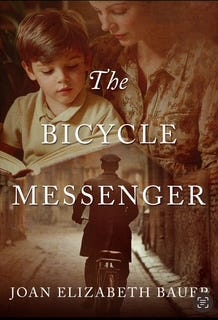
Some excellent October reads.
I’m pleased to tag #OpenBook Linkup on CatholicMom.com. Thanks to Carolyn Astfalk for hosting this opportunity!
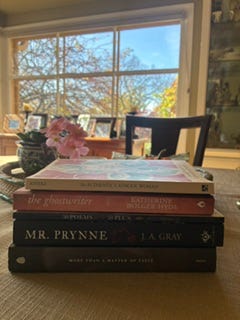
Today, I offer several short reviews in no particular order.
by J.A. Gray
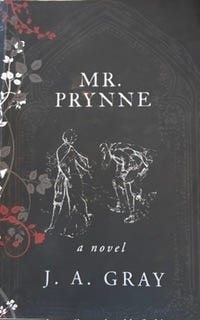
Nathaniel Hawthorne’s The Scarlet Letter is one of those classics of American literature that many people read in high school or college, but that’s not a prerequisite to enjoying this excellent adaptation. In Mr. Prynne, Gray gives us a faithful retelling with an important twist: he adopts the point of view of Hester’s estranged husband Roger Chillingworth, who resumes his true name and relationship to Hester in the book’s title. My full review is forthcoming in Catholic World Report.
by Catherine Bolger Hyde
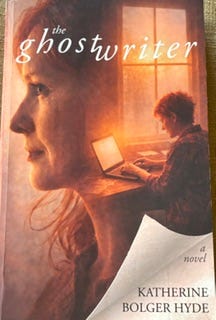
Newly divorced and down on her luck, former journalist Margaret Thompson agrees to impersonate her reclusive twin sister Maeve O’Shaughnessy, an acclaimed novelist whose ochlophobia prevents her from making public appearances. With this elegant, tragicomic premise, The Ghostwriter examines a question many women face at midlife: how do I reclaim a self that is properly bonded in love and yet fully distinct?
These particular twins are connected by more than genetics; at times, they experience one another’s thoughts and feelings almost telepathically. As narrators, Margaret and Maeve occasionally merge into a third “character,” Maewit, who safeguards their shared childhood memories and dreams. But a lifetime of compensating for one another’s weaknesses has left the two women dangerously codependent.
When Maeve is injured in an accident, Margaret steps in as ghostwriter to finish Maeve’s work-in-progress so that Maeve’s publisher might eke out another bestseller. But the implications for Margaret’s own life are enormous. Hyde raises powerful questions of identity, faith, anxiety, and the age-old human desire to control circumstances and outcomes. At first, Margaret believes that she can write her preferred life story into existence. But in reality, she must repair the broken relationships in her life through authentic conversion. Her guide in this process is the kindly Father Sergius, a Russian Orthodox monk who temporarily rents a spare room in Margaret’s Victorian house. Through his personal presence and also through his intercession, Father Sergius helps Margaret see that God uses trial and distress to mold and stretch our hearts until we can better reflect His divine image.
Simply told but elegantly crafted, The Ghostwriter alternates between San Francisco, where there is always a croissant, a delicious latte, or a perfectly brewed cup of tea to enjoy, and Maeve’s rustic and isolated mountain cabin, where a cat can be free to roam the woods. Throughout the book, the strain of family relationships rings painfully true. When Margaret’s young adult daughter Kimberly balks at letting her mother stay in her apartment near the hospital where Maeve has been taken, Margaret asks herself, “Had she really raised this creature?” Later, Margaret struggles to eat her Thanksgiving dinner from a hospital tray at her sister’s bedside:
Margaret was hard pressed to be thankful even that she herself was alive and unharmed. Maeve’s role in this drama seemed so much easier than hers. Typical of Maeve to drop out and leave Margaret to face the music. Oh, what a horrible thought! She forced herself to eat out of penitence.
Part Parent Trap, part Cyrano de Bergerac, The Ghostwriter tells a compelling, heartfelt story while adding a welcome Orthodox perspective to the literary conversation.
Fifty Poems for the Fifty Plus
by R. G. Braier
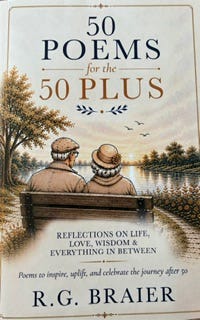
A dear fellow member of the St. Vincent de Paul conference at our parish has just published this engaging collection of poems. Unsurprisingly to those who know him, Braier brings great gentleness to these meditations on the quiet pleasures of later life, from pickleball to yoga, jigsaw puzzles to chess. The couples in these pages visit old stomping grounds, attend mass together, and read to their grandchildren; they develop wrinkles, lose their hair, and suffer aches and pains. But they accept these signs of aging with grace, even gratitude. As they remember their lives, striving meanwhile to take good care of themselves, they continue to honor the One who made them in His image, passing along their faith and renewing their own sense of wonder in their encounters with children. I’ll just share a few stanzas from one of my favorite poems, Beyond the Day, addressed to a cherished love separated by distance:
Years made us fluent in the unsaid things:
How joy can ache, how absence can be kind,
How every parting seeds a tender root
That blooms in rooms we carry in the mind,
A garden watered mostly by ‘someday.’
We might have built a house of ordinary days—
Keys in a bowl, your coat beside my own—
But fate misplaced the door, or we the key;
So love became a country overflown,
Seen clear from heights we never could descend.
This book would make a lovely anniversary gift for parents or grandparents.
More Than a Matter of Taste: The Moral Imagination and the Spirit of Literature
by Joshua Hren
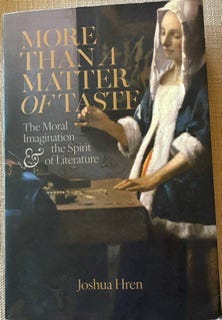
It’s a joy to examine beautiful books over the shoulder of a gracious person who has studied them deeply. In More than a Matter of Taste, Joshua Hren unites professional literary exegesis with a clear and radiant faith that ranges comfortably from the ancients to the Church Fathers to modern philosophy in order to develop a consistent and coherent morality of reading. To paraphrase the mission statement of Well-Read Mom, we might ask, what does it mean to read well? Hren answers the question thus:
Literature, which trades in the tangible and textured, which delivers a higher vision through a patient and painstaking representation of the real, is especially well suited to increase the depth perception of our souls—to enhance our vision beyond the empirical.
This project is quite distinct from increasing our empathy, which, according to Hren, serves mainly to make us feel good about ourselves. Hren refutes common categorical errors and teases out the full implications of moral systems grounded solely on empathy, thus making the case in reverse for a worldview grounded in the saving action of Christ. We must learn, not only to feel and condone, but to see.
This book discusses many of my favorite writers of fiction, from George Eliot to Marcel Proust, from Dostoyevsky to Conrad to Joyce. I had already read some of the novels Hren cites, but many I hadn’t. In the latter case, I enjoyed experiencing an unknown work in miniature. And Hren’s take on familiar works often surprised me and enhanced my appreciation. In Swann’s Way, the first book of In Search of Lost Time, Hren traces the outlines of Proust’s sacramental imagination, something I’d always sensed but couldn’t fully discern. He shows that the mother’s goodnight kiss is in fact Eucharistic while carrying overtones of the binding of Isaac. For a reader who would like to embark on this novel, Hren’s essay would make a very good start.
The essays in More than a Matter of Taste also reflect on present-day culture. In an extended discussion of Dostoyevsky’s The Possessed, Hren shows us how the ancient heresy of Gnosticism persists in our present-day politics:
In a dynamic that will find widespread purchase in modernity, faith and intuitive reason are replaced by secret knowledge, and intellectuals begin to lead Gnostic mass movements.
In other words, those who possess the secret of things—whether that’s education or wealth or access to the powerful—tend to lord it over everyone else. Sound familiar?
This excellent book offers calisthenics for the mind, even as it partially demystifies a challenging read like Finnegans Wake. But the reward is well worth the effort. In a paraphrase of St. Augustine’s response to difficult passages in the Bible, Hren writes,
Difficult passages in texts function as a sort of blessed puzzle, activating the intellect and imagination and rewarding contemplative exertion.
I walked away from this book thinking that the grandeur of God so permeates the world He has made that even a secular writer can’t avoid revealing His imprint on the soul.
by Genevieve Kineke
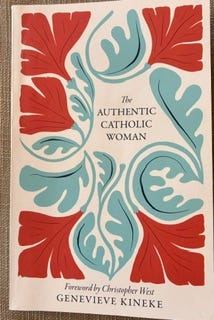
When I started reading this book, I immediately wanted to recommend it to all of my Catholic friends. Kineke grounds her work on femininity in the biblical image of the Church as a bride, with Christ as the bridegroom. This book contains chapters on how women specifically image the sacraments; and in the end, it points to the unique ways in which women, in the fullness of their receptivity, can rebuild culture. If we are looking for a catchall phrase for this, it would be spiritual motherhood:
God wants us to understand the supernatural reality into which we have been invited, the spiritual dimension of motherhood. Essential to this is remembering that it is the motherhood of the Church that we are striving to imitate.
This opportunity is open to all women:
all women are called to shower their motherhood on the world in the particular ways that God makes possible. The single woman, the barren wife, the widow and the consecrated bride of Christ will all be given opportunities to exercise motherly hospitality: to shelter others, to harbor the lost, to love the unmothered.
This discussion particularly resonated with me, especially because my own novel, The Bicycle Messenger, concerns the mothering of a child who suffers from mental illness. Kineke raises the example of a mother who nearly kicked out her struggling son. The family in question avoided this disastrous outcome when the mother realized through counseling that she had to
respond with the constancy of the Church when it came to this difficult child. She must love him when he was unlovable, she must smile at him when her heart felt like breaking, and most of all, in those times when she felt that he didn’t deserve it, she must give the gift of herself to him.
To me, this dovetails perfectly with this year’s theme for Well-Read Mom, which is Year of the Woman.
You can find more of Genevieve Kineke’s excellent work on Substack at The Feminine Genius under the heading of Domus Aurea, or House of Gold. Beginning on November 29th, The Feminine Genius will offer a three-week online course featuring the O Antiphons. You can register here.